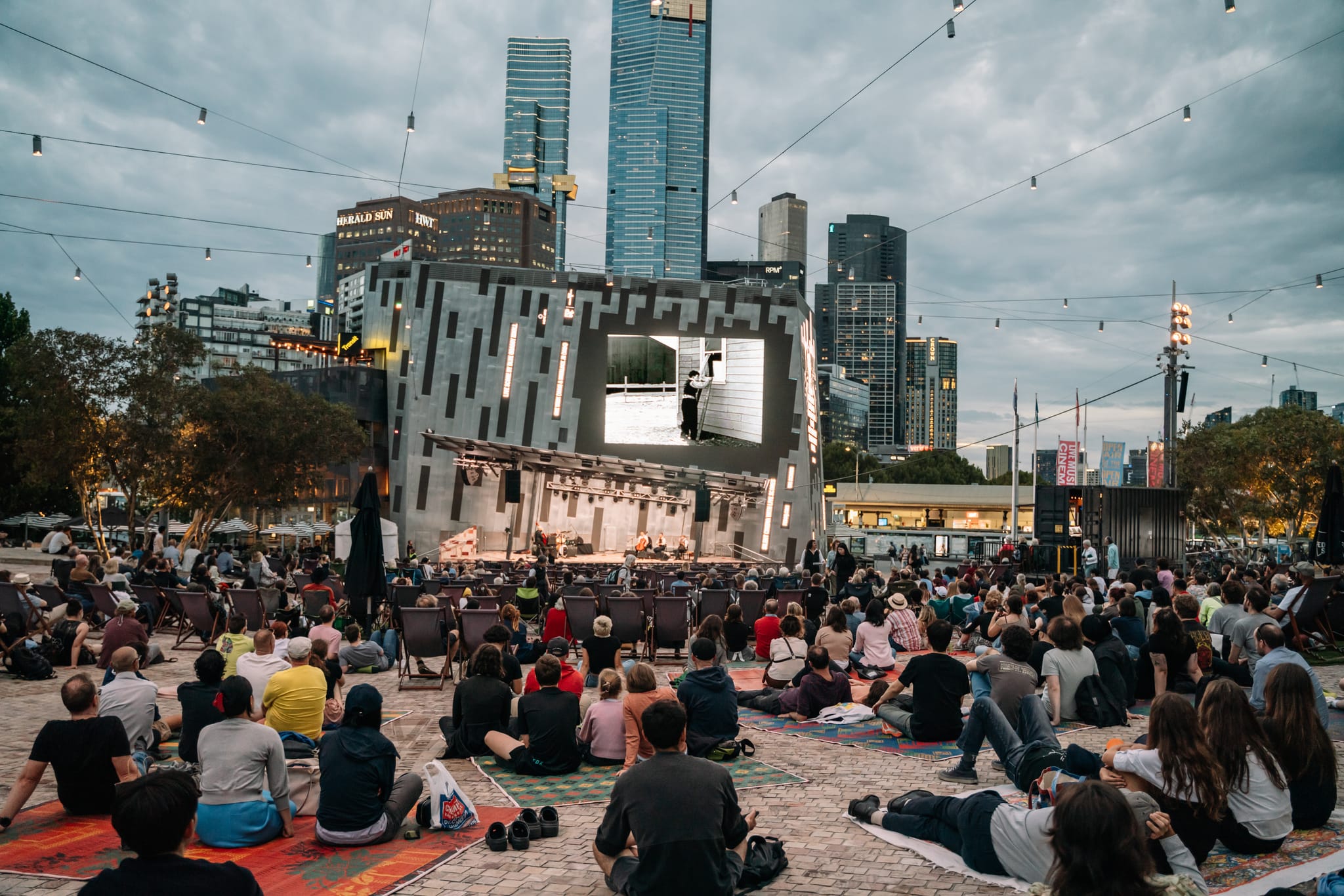
Think for a moment of ‘the cinema’. Picture it in your head. What comes to mind primarily, no, is an image of a darkened room indoors, illuminated only by a movie, a carefully controlled environment separate from the natural world. But now, think beyond the box, and outside of that image exists another kind of cinema: outdoors. Like in the photo above. From mobile screens and drive-ins, to dedicated venues and amateur set-ups, there exists a long tradition of exhibitors offering other ways of socially experiencing moving images and their accompanying sounds together. Albeit a tradition less common nowadays.
Amongst those keeping it going is Naarm Melbourne’s Fed Square, with Outdoor Cinema programs presented throughout the year on the Big Screen, a giant, 65 square metre TV made up of 850 LED panels and 4,000,000 pixels at 6mm pitch. Importantly, for a truly public space, these programs are free to attend and access for anyone able to make it into the heart of the city.
As part of Fed Square’s free Open Air at the Square events taking place this February, our editor talked to Ben McCarthy, Fed Square’s Film Programmer, about the film program, and what curating for the public outdoors involves.
This week specifically sees the return of Fed Square’s free Silent Cinema with Live Scores series, a weeklong showcase from 16-20 February of some of silent cinema’s most celebrated films from Australia, France, the US and China, as brought to life with live scores performed by renowned DJs and some of Australia’s leading musician-composers. Spanning history, horror, drama and comedy, with music that traverses gypsy bluegrass to experimental electronica, the full line-up is:
- Monday 16 February, 8 pm: For the Term of His Natural Life (1927), with hybrid soundtrack by DJ Lori
- Wednesday 18 February , 8 pm: The Adventurer (1917) with live score by Sally Ford and the Idiomatics, followed by Modern Times (1936) with original recorded score
- Thursday 19 February, 8 pm: The General (1926), with live score by Blue Grassy Knoll
- Friday 20 February, 8 pm: The Goddess (1934), with live score by Mindy Meng Wang and Burkhard Dallwitz
- Rescheduled to Wednesday 25 February, 8 pm: The Fall of the House of Usher (1928), with live DJ set by Emelyne
Earlier this month meanwhile saw In Defence of Satire, a razor-sharp series that presented critically acclaimed and cult-status satires inviting, and still inviting, audiences to consider the continued power of satire as a form in exposing the chaos beneath modern society’s polished surface: Dr. Strangelove (1964), Network (1974), This Is Spinal Tap (1984), and The Player (1992).
Long intro out of the way, below is the longer interview (edited nonetheless for brevity). A shorter interview with Ben can be found here.
Question: I’m interested, to start, to get an idea of your role as film programmer. What does that entail in the lead up to Fed Square’s Outdoor Cinema programs, and how far in advance?
Ben McCarthy: We tend to work around 12 months ahead. As soon as we finished last year’s outdoor cinema program, we already had a really good idea what we wanted to do this year. Then it’s more about finalising all the paperwork and licencing and everything else. But I feel for being a film programmer at Fed Square, it’s trying to give the public something new and something different every time. That’s a great creative inspiration and challenge every year. Also, with the films that we select, whether it be this program or any others, we try to understand not only what’s happening around the city but look at films that haven’t really been screened free and for the public before. And really try to push the boundaries, especially within a large, free public space that we work in, in the middle of the CBD.
Q: What are your aims in terms of programming an outdoor program in general?
Ben: Regardless where the location of the cinema is, whether it’s indoor, outdoor, or even actually in someone’s home cinema setup, I strive to create a communal experience. I think that is incredibly integral to what cinema is to me, and the films that we select. My favourite recent example is admittedly The Lord of the Rings films that we’ve just done- the extended editions- and what was really lovely about that was, it felt across all three of those nights that it was a big communal experience where the people who came were very much already invested, and would obviously come back. Which then led up to, on the last night with The Return of the King, some wonderful crowd interactions. I think very much of the Éowyn moment towards the end where she says, “I am no man”, then you hear the entire Square erupt with applause, and things like that. That’s one part of what we try to aim for.
The other is to really start conversations with the films. In particular, with our In Defense of Satire program, it is obviously the whole thing of, we are looking back to go forward, in how even more relevant these films are compared to where we are now. Having an open dialogue with each other, with different parts of the community, is something, as a public square, that we strive to do.
Q: I’ve been along a few times in the past, and it was quite fun engaging with film in a different way, because it’s more acceptable to talk while watching and be loud and move.
Ben: Yeah, you know, it’s recognised in the environment that we’re in. You are deep in the middle of the city. Everyone is able to create their own space within the Square, whether it be to talk to each other or not, to walk towards the screen and things like that, and for it not to really affect anyone else around them. Also quite wonderful to see.
Q: I don’t know if you’re monitoring or there’s someone monitoring, but do you have an idea of how many people tend to rock up to these? Of people who stay or just pass through?
Ben: Yeah, what we tend to notice is that there are two types of audiences that come. Predominantly, we do have an audience who come and strictly be there to watch the film. I think on average we tend to get around 200 people for each screening. Depending on the film, it can increase. For The Lord of the Rings, across each night we probably had around 500 people. Some of our most popular ones, our Studio Ghibli afternoons during [last year’s] April school holidays, we had a double bill of My Neighbour Totoro and The Cat Returns and close to 1000 people, which was really quite amazing.
And then the other side is very much that transient, pub like crowd audience, who may not know what’s going on. And they will tend to come to the Square, watch the screen for 5, 10, 15 minutes, and then carry on to their next destination, which is really great as well, because I think even then they are engaging with the program in one level. Similar to, you know, whether it be watching reels on Instagram or YouTube shorts where you obviously watch specific scenes or clips in very short durations.
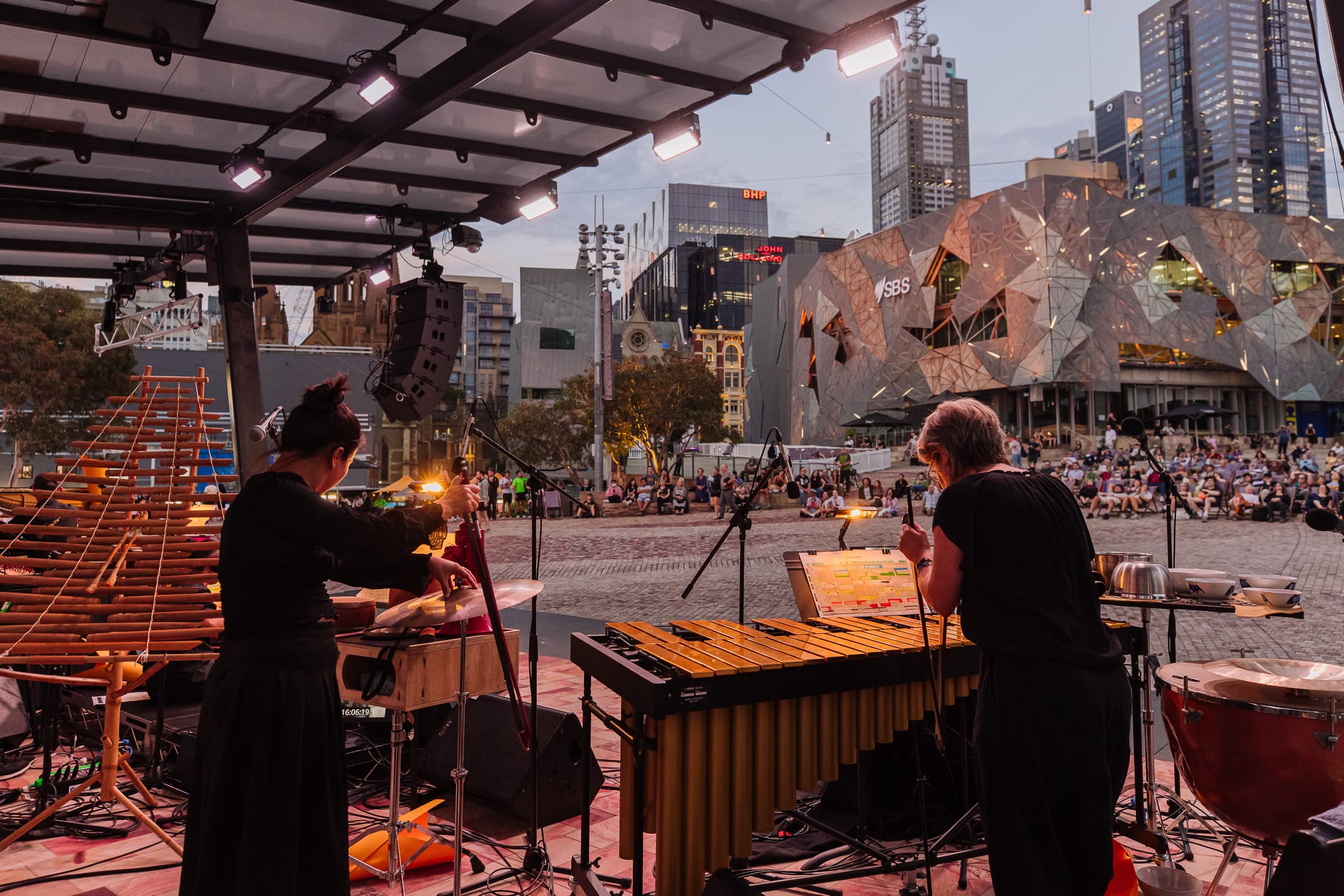
Q: For February, there’s [already been] the In Defence of Satire series. And then [next up] there’s the Silent Cinema with Live Scores. To focus on them one at a time, the Silent Cinema with Live Scores, do you want to talk through how that came about? Because that’s a continuation from previous years, but with new films, or old films but, you know.
Ben: I think that we always see our Silent Cinema with Live Scores program as a perfect marriage between our film program and our music program that we have in the Square. This year, we wanted to experiment a little bit with DJs and electronic music for some of the films. The first two, For the Term of His Natural Life and The Fall of the House of Usher, both of those will be scored by live DJs. DJ Lori with her hybrid score on the first night, and then DJ Emelyne. We really wanted to push the boundaries musically and creatively for those two films, and in particular For the Term of His Natural Life. That was a really exciting opportunity to screen the most expensive silent film in Australian history. And it’s also a brand new restoration from the National Film and Sound Archive that was only shown [first] last year, and it’s absolutely fantastic.
Then for The Fall of the House of Usher, the horror genre in the early silent era is an absolute treasure trove of film history and experiences. They were inventing the language of horror cinema, using all the cinema techniques that they learned in the early 1900s. What [director and co-writer] Jean Epstein did with that film is nothing more than extraordinary. It’s such a hallucinogenic film to see and experience. Just to see that here is fantastic.
With the other films, that’s where it’s a more traditional marriage between bands and orchestras creating scores for those films themselves. Whether it be Blue Grassy Knoll coming back again for The General, its 100th year anniversary. It’s a really exciting silent cinema masterclass from Buster Keaton, seeing how that’s influenced multiple films in the decades gone by. Whether it be action films in one of the most recent Mission: Impossible films, with the train sequence at the end, and even say Back to the Future Part III.
The entire program- it’s a wonderful collaborative process to ensure that the musicians have that kind of creative and emotional connection, to allow them to create a score that best encapsulates not only their own interpretation, but also their emotions towards the film. It’s really exciting.
Q: Do you select the films first and then find musicians and artists to pair with them? Or do you find musicians and artists that you want to spotlight, and then the film comes about after that?
Ben: It is very much working with the artists first, and then the films come. We research the artists that we would like to work with, then have conversations with them in terms of understanding the films and genres that they respond to, the overall experience that we want to have in the Square. Once we have a great idea of what the artists are gravitating towards, whether it be specific genres, themes, filmmakers, or anything like that, we then curate a list for them to help choose from. What we find is very, very quickly through that process, we tend to narrow down on a said film. Pretty easily, and that’s why I enjoy the process, and why it’s a wonderfully collaborative process, and hopefully the proof is there, from last year’s program to this one.
Q: I remember last year there were some really fun sound effects that arose from those musicians and groups accompanying the films. Makes me think back to how they would have been originally experienced. I’m sure some groups had fun as well, or did their own little unique twist, place to place.
I caught For the Term of His Natural Life at the Capitol last year when it debuted, and found it to be… dated in a good way, in terms of showing a bit of Australiana that we don’t get much of in cinema- that time period. To jump from that, I guess sort of awkwardly, I’m interested to know if you have any thoughts on Australian cinema as it exists at the moment?
Ben: Yeah, it’s an interesting one. I’ve always really enjoyed the genre making within Australian cinema. I think that that’s really the strength. One of my favourite modern Australian genre movies is [fittingly] The Square, directed by Nash Edgerton, which is a fantastic kind of Coen Brothers-esque movie. No doubt, a movie that had limited resources, but used [them] to its absolute maximum, and I think that’s always been Australian cinema’s strength. What I also really enjoy is the emergence of a lot more short film festivals. Because short films do need to be platformed a lot more; there’s such a wealth of creativity and craft in them but it very much is a lost art. Whether it be the St Kilda Film Festival that is absolutely fantastic and even actually seeing something like Tropfest being brought back this year, that’s also a great thing to have. And also, slowly even more films being made by the LGBTQIA community is really great. I watched Of An Age. Seeing a film that was that personal and that tender, represents another part of Australian cinema, is fantastic.
I’m very optimistic in terms of what the future holds. That even goes to say, the infrastructure that’s in place, whether Docklands Studios here, and Gold Coast. There are some fantastic local distributors as well, people like Umbrella and Madman constantly supporting and funding Australian cinema; it branches out even further than that, through physical media, and supporting that aspect is important for Australian cinema too, keeping that film culture alive.
Q: On the other hand, from the Silent Cinema program, looking internationally, something like The Goddess stands out to me as a very cool example. Australia, Melbourne has a big Chinese community, but we don’t see much of the Chinese film industry going back that far. I don’t really have a question. But just a very cool one to discover in this program. I’d never heard of it before.
Ben: Yeah, no, The Goddess is very much a landmark in Chinese cinema. The themes in that movie also still speak to a lot of global themes, really, of social injustice and redemption. Seeing people who are doing their absolute best to create a life for themselves and to also support everyone around them. And I think that that film is a beauty. That’s actually one of my favourites, that I’m looking forward to, because I’ve only seen it with its original track. I really cannot wait to see what Mindy Meng Wang and Burkhard Dallwitz do with the film score. But again, I think, it goes back to, with any of our film programs: push the boundaries and try to think more outside the box, and try to select films that aren’t as well known to not only the general public, but also hopefully, I think within the within the cinema lover community as well.
Q: How did the Satire series come about and how did you select the individual films? Did you have a lot of creative freedom to put that together?
Ben: Yeah, I am very fortunate to have to have creative freedom as a film programmer here, and what comes with that is a sense of responsibility to be a little bit adventurous. That’s where I see the In Defence of Satire program, compared to other outdoor programs that I’ve done. Because in each of those films, they address elements of current pop culture, and the political landscape, whether it be in Australia or anywhere else.
I wanted to dive into those themes. The geopolitical landscape between multiple superpower countries, which is showcased in Dr. Strangelove. The role of news and media and how maybe the news is becoming a bit more commodified and a bit more commercialised, and how that’s being reflected in society, that Network is a textbook showcase in, even going as far as the public sentiment through Howard Beale, in his famous monologue. Then, there’s obviously been a lot of talk about the music industry, whether it be the role of AI and the notion of algorithms. And also, how the industry has become even more extravagant in its tours and the artists and the work they have to do to get their music out. Looking at This Is Spinal Tap as this comedic roller coaster of emotion.
At the end of all of that, you then look at the movie industry itself. More and more as each year passes, you see the role of intellectual property in cinema and how streaming services curate their platforms, the various choices that they make. So, I thought it was a great opportunity to screen one of the great modern movie satires in The Player. With great fortune, with the recent success of the Apple TV show The Studio as well. It’s kind of come at a perfect time. It’s an opportunity to showcase these films to a new audience, whether it be students or teenagers or people who haven’t seen these films before. And for the first time on a big screen. But on top of that, for film lovers who would have seen these films multiple times, it’s another opportunity to go back and re-examine them all.
Q: I imagine there’s some scenes in the films which go quite well in a public space, such as the monologue from Network, the bomb scene from Dr. Strangelove. I’m sure those have an interesting connotation being played like that.
Ben: Absolutely, couldn’t agree more. I think it’s because in all of those moments, there is an element of truth to them that will always resonate. I’ve had a lot of fun revisiting and rewatching those films over the past couple months, in particular Network, because when I first saw it, I think maybe when I was a film student, when I was 18, 19, the humour didn’t quite land for me. But now, obviously more so. Also, rewatching that movie- how sharp that screenplay is, and the performances. Faye Dunaway is fantastic in that as a TV programming director constantly chasing ratings. It’s exciting to be able to showcase these films on the big screen.
Q: Why does satire need defending? Why is the program in defence?
Ben: I believe that at any given time, everyone needs a laugh. We need to sometimes laugh in the situations that we are as a way to process what’s happening. And also I feel that satires themselves are a lost art at the moment. Even with film satires, there aren’t very many around. And so I think because of that, it’s almost like, well, we need to bring the satirical minds and films kind of back. Showcasing this program is really, as we say, in defence of the satirical genre.
Q: Young people who maybe are interested in getting into film programming or exhibition, do you have any advice that you’d give them, or any thoughts looking back on your own journey into film programming? I don’t know if, when you started out, you thought you’d end up at Fed Square doing this.
Ben: No. I mean, my original goal was to be a filmmaker. Was to be a director, same as everyone else. To be the next Spielberg, or whoever. But I think through that, what I realised is, that wasn’t quite my strength. And so I’ve been very fortunate in the experiences I’ve had- whether it be working in television programming and curation- that led me to this, to where I am now. What I always recommend to anyone, mainly, is just to keep watching films, keep reading about films, on ScreenHub, or IF, or Empire Magazine; anything like that, you’re learning about it. And also be adventurous in your own film watching choices, and try to kind of develop your own taste in films, what you gravitate towards.
What I’m really enjoying, and this is something that I wish that I had growing up: Letterboxd. As a film programmer, it’s a great tool for me to use in terms of, not only helping curate my own private list, for research and things like that, but sharing my own curated program list with friends or anyone else who wants to follow. Setting up movie nights with friends, also something that’s great. Volunteering at film festivals, I highly recommend. I volunteered at the Sydney Film Festival a few times. Get involved in short film festivals. And independent film festivals, whether it’s the Environmental Film Festival Australia, or things like that. Like, just try to constantly, actively be engaged with the community, and where possible go to the cinema, go to talks.
I’m a really big fan of the Kermode and Mayo podcast, the one they’re doing in England. The film critic Dr Mark Kermode always said that in order to treasure the good films, you have to experience the bad ones as well. Even a film programmer, you really do have to try and watch as much as you can, if it’s good or bad, because then I think from that you’ll be able to cultivate your own personal, personal taste, but also your own kind of programming sense as well.
Q: I used to listen to Kermode and Mayo, or not listen, watch their YouTube videos. Maybe I’ll have to look up their podcast.
Ben: I definitely recommend. As Dr Kermode has gotten older, it’s a really great treasure to listen to as an audience member whenever he does reassess a film. Time can really affect how your response to a film can change, and that’s something that he’s been a bit more open about in his most recent podcast with particular films.
Q: Like you said before, like Network. I was looking at your Fed Square interview, and they asked, “What are you most excited about in the program?” And you said, “Everything!” Maybe to put a different spin on that, are there any achievements or parts of the programs for February or beyond that you’re especially proud of. Maybe there was something that was very difficult to make happen, or there’s just something that you were really happy to put out there in the world for more people to see.
Ben: What am I really proud of? There’ll be a couple. Going back to the Studio Ghibli afternoons, I’m really proud of that one, just because Ghibli themselves, is a fantastic studio, and all their films are beautifully positive, they’re all such a delight, and you want to treasure them all so much. Seeing parents bring their young children- could be 3 to 6-years-old, and so it’s their first experience of seeing those films- that, to me, is just so beautiful. And I treasure that because, my first cinema experience, I think, was like Tom and Jerry: The Movie in 1992.
I’ll also say the recent Psycho Halloween screening I’m very proud of. Seeing that horror film in an outdoor context, in a public square, was a really big thrill. And seeing the people who were there really respond to it was fantastic. Whether it be the famous shower scene or where they find mummy dearest, all that stuff is really, really fantastic. It was 9 pm on a Friday night, and Halloween was on Friday 31st. I mean, you only really get that chance maybe once every 7, 8 years. Might as well do it.
Lastly, I think it’ll be a personal one, because I do love my blockbusters. I did a mini Christopher Nolan program last summer that I was really happy with. I do love to go see his movies at the IMAX. But seeing everyone there for those films in summer was a real thrill. His movies, I always consider them to be my Star Wars, effectively, and as an emotional experience for me, even if it’s seeing the 18-wheeler flip and hearing the score from Interstellar. Really, really, really fantastic.
But then linking back to our satire program again, I think all of the scenes spoken about, seeing them in a renewed context. With all these films that I saw when I was a teenager, being able to program them here is always something that I’ll be immensely proud of, and I’m very fortunate to do.
Oh, actually, the last one: we screened Blade Runner in October 2019 as a way of, “This is what Blade Runner thinks the world is like in 2019″. Unfortunately/fortunately, it’s not quite like that. So, yeah.
Q: That’s a perfect one, I think, for the [Blade Runner-looking] Fed Square Big Screen. Maybe one day we’ll see the The Odyssey at Fed Square.
Ben: Hopefully, hopefully. But yeah, no, we definitely have got a few ideas for next year and a couple of films to rewatch. Should be good fun.
Fed Square’s free Silent Cinema with Live Scores series runs each night 8 pm onwards from 16-20 February.
Ben McCarthy is a Film Programmer who has worked at Fed Square for over seven years, curating the outdoor cinema program for the Big Screen. He studied Film Production Technology at Staffordshire University, graduating in 2012. A shameless fan of big blockbusters, his favourite films are Goodfellas (1990), Heat (1995), The Shawshank Redemption (1994) and The Dark Knight (2008). Some of his recent favourite films are The Substance (2024), Sinners (2025), One Battle After Another (2025) and Parasite (2019). Ben’s Letterboxd handle is benmccarthy1990.
 MELBOURNE UNIVERSITY FILM INQUIRER