By Johnny Hill
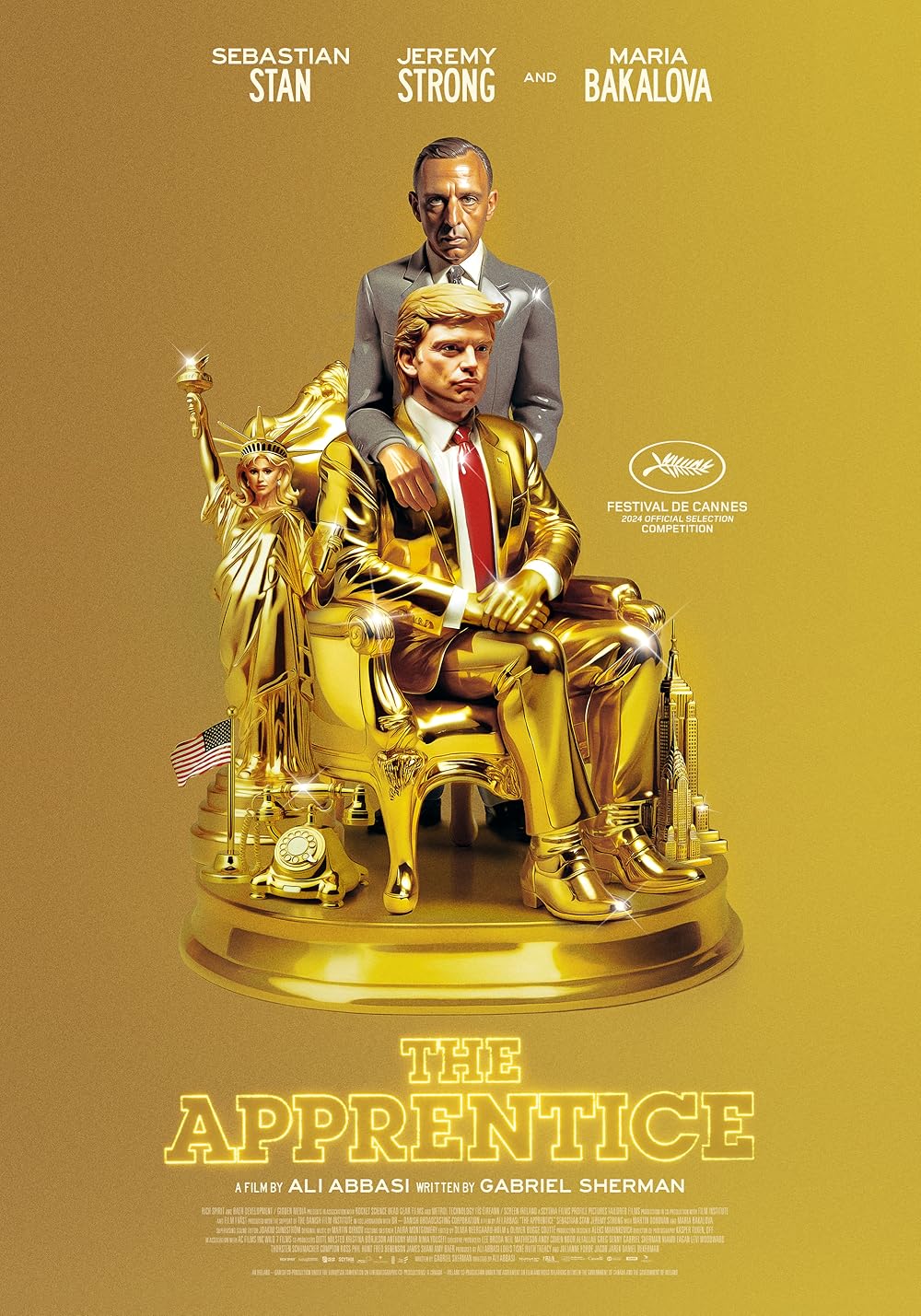
When Donald J. Trump decided to erect his sky-scraping Trump Tower in New York in the late ’70s and early ’80s, he also destroyed the previously standing building – that of luxury retailer Bonwit Teller – along with the historical art deco sculptures of the department store that were promised to the Met, solidly placing a young Donald Trump as a lying enemy to art. Of course, years later, everyone across the world has become aware of his self-indulgent antics, including Ali Abbasi, the Iranian-Danish director of 2024 film The Apprentice – a morbid bildungsroman that outlines the rise of Trump and shows the world that behind greedy sharks also exists those who feed them. Whilst Abbasi and screenwriter Gabriel Sherman’s audacity and timeliness in attempting to create art out of an artless man can be applauded, I was left by this film with a profound sense of indifferent disgust – much like viewing Trump on the news today. Although an entertaining affair, I could not help thinking that the film ultimately copies the same superficiality of its subject, presenting me with no profundity but instead the images of destroyed marble and another dull reminder of late-stage capitalism.
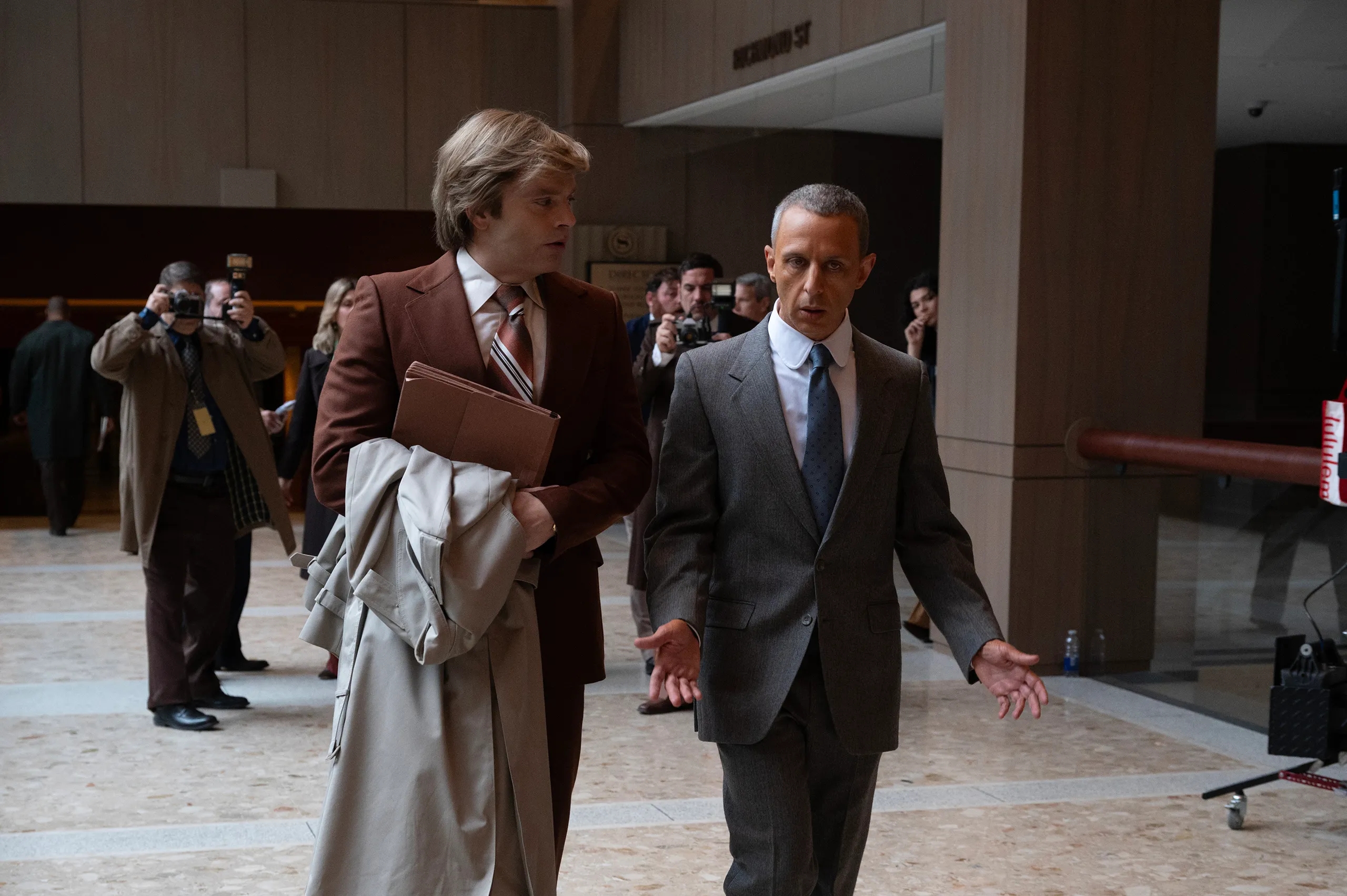
Far and away the best part of The Apprentice is the first half, which features the Frankenstein’s monster-esque dynamic between Donald Trump and his lawyer-advisor Roy Cohn. Excellently played by Jeremy Strong – no stranger to depicting idiosyncratic, greedy millionaires – we watch as Cohn slowly nestles Trump under his wing, transforming him from an insecure man living in the shadow of his father, to the megalomaniac one knows him as today. Strong is able to outstandingly capture the inherent sliminess that exists in a man like Cohn, imbuing every action with small and large hints of his domineering lust for power and control. Whilst this performance may shine, there is also no denying Sebastian Stan’s lifelike depiction of Trump, with both Stan and Strong playing off of each other expertly.
Moreover, the film is imbued with a graininess and unsteadiness. The camera constantly moves, floating freely around characters and shaking even in the stillest moments; the 16mm film overlays a blurriness to the movie – like Vaseline over a lens. Both work to remind the audience of the detachment of the characters on screen – indicating that this is a life not of reality or of taking everything in, but one of pinpoint focus on solely what can make one money in the shortest and easiest path. For most of the film, the camera orbits around its subjects like celestial bodies, highlighting further the egos of those on screen, who seem to even expect the camera to move around them.
This kind of stylization is effectively what carries The Apprentice throughout its runtime. Somewhat making up for what its subjects lack, The Apprentice certainly has a strong visual feel that, in the first half of the film, creates an exhilarating air of hedonism that also seems destined for destruction. And its fast-paced editing and noisy needle-drops convey the atmosphere of excess and greed all the way through the 70s and into the 80s Reagan-era.
Once Roy Cohn recedes into the background, however, the movie devolves into a one-note portrait of Trump himself. Filled with extremely on-the-nose lines such as Trump proclaiming that he would never run for president, The Apprentice seemingly abandons any notion of detail in favour of aggressively nudging the viewer and presenting the Trump we know all too well in a style we all know too well. Whilst maybe this shedding of façade mimics Trump’s similar one-note personality and wickedness, it also starts to feel like a too long skit, where every knowable Trump-idiom is repeated for the sake of repetition. Instead of any further analysis of why Trump is like he is, The Apprentice instead opts to show his greed for victory and his horrible acts without comment. Although this is bold in the political polarisation of today, it also does nothing profound in attempting to show why Trump has turned out so horrible amidst the other billionaires who also seek power and fame.
While The Apprentice is somewhat successful in showing the terrible things Trump has done, it becomes a rote affair – repeating bad act after bad act that beats the viewer over the head with a bat they have been beaten over the head with many times before. Especially after one particularly shocking scene, The Apprentice seems to leave the audience to question why we are actually being presented with these acts. 30-minutes into the film we understand that everyone involved in this story is a monster; why should we have to continue to bluntly watch them be the monsters that they are?
Overall, The Apprentice is certainly a morbidly entertaining and lightning-quick affair, but it is also nothing new under the sun. Either a masterstroke of meta-storytelling that gives the same repulsive feel as watching billionaires repeat the horrible and greedy acts of each other, or a bland and superficial depiction that shies away from actually questioning why a horrible man does the horrible things he does in order to perhaps try and change some foolhardy minds who have so far ignored that horribleness. To find the answer of what The Apprentice actually is, one may have to wait twenty-or-so more years. Probably also the same time this film should have come out.
The Apprentice can be seen in cinemas now. And Donald Trump many other places too.
 MELBOURNE UNIVERSITY FILM INQUIRER