By Lachie Carroll
With the release of Megalopolis in Australian cinemas, I am now plagued with the almost insurmountable task of condensing this singularly bizarre film into a coherent review. The production difficulties that faced Francis Ford Coppola’s new epic, the film first being conceived almost half a century ago, are, for better or for worse, inseparable from Megalopolis itself. The film’s $120 million price tag, which made headlines before its world premiere at the Cannes Film Festival, was entirely self-funded by Coppola, who sold part of his wine empire in order to get the venture off the ground. What could be understood as an admirable feat of passion on Coppola’s part has, however, been underscored by reports of a dysfunctional and creatively divided set, including extremely serious sexual assault and misconduct allegations from extras who worked on Megalopolis which paint this production in an entirely different light. What results is an ironically self-referential film that clearly spells out the havoc behind the scenes.
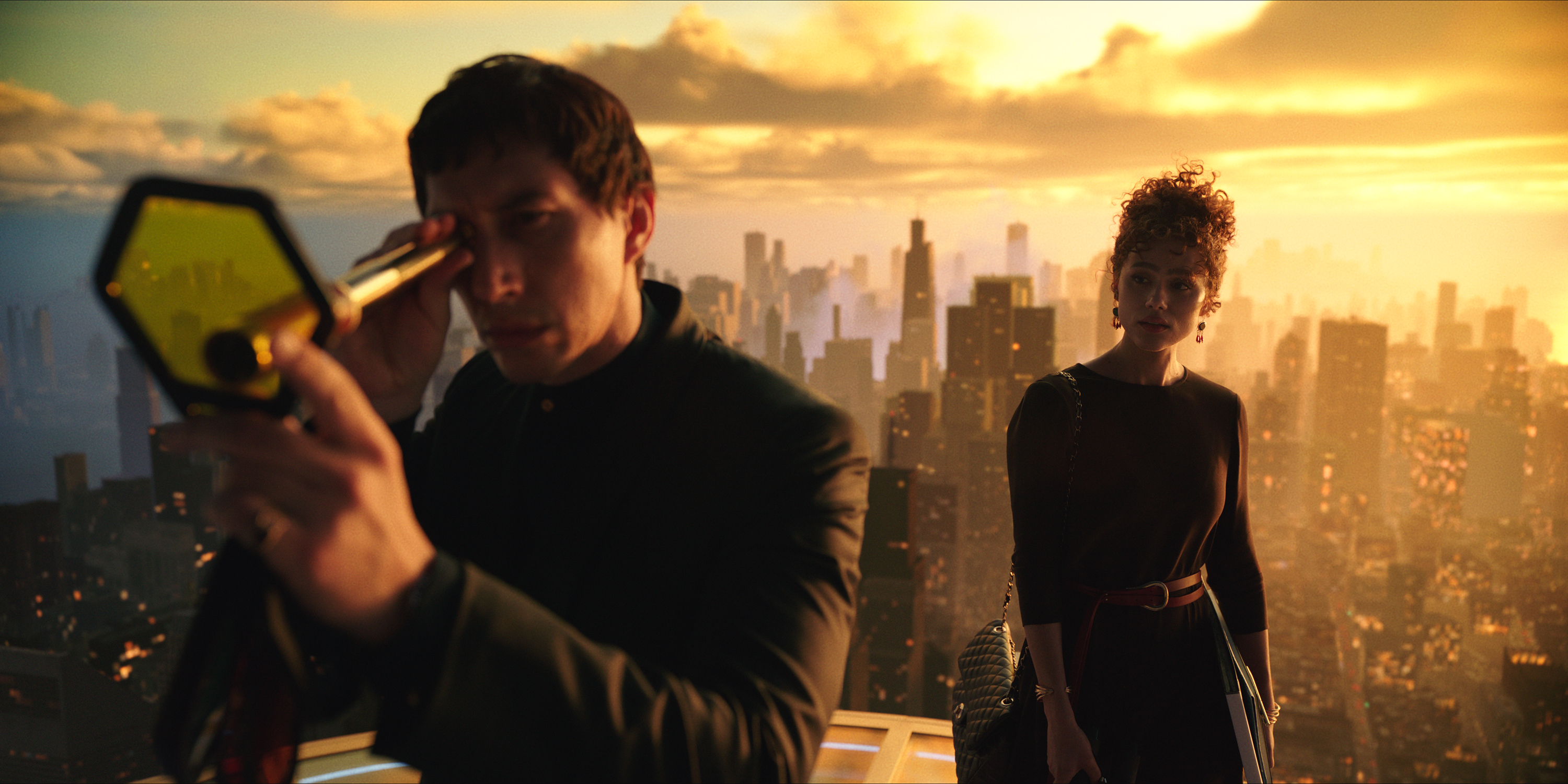
Megalopolis is set in the futuristic “New Rome”, a scarily familiar version of New York City from the third millennium. Many of the socio-economic problems facing the city, such as the threat of authoritarian government and an escalating poverty crisis, echo the current issues found in the real-life United States, Coppola offering his film’s setting as a cautionary tale as to what could unfold should these problems go unchecked. In New Rome, we follow Cesar Catilina (Adam Driver), an ambitious architect with time-stopping superpowers who seeks to build a new utopia in order to eliminate the unrest in the streets. Catilina finds himself in constant opposition to New Rome’s mayor, Franklyn Cicero (Giancarlo Esposito), who deems him recklessly ambitious, while Cicero’s daughter, Julia (Nathalie Emmanuel) finds herself sympathetic to the futurist’s cause. Rounding out the film’s key players are a monopolizing banker (Jon Voight), a materialistic TV presenter (Aubrey Plaza), and Clodio Pulcher, Cesar’s jealous cousin (Shia LaBeouf). This ensemble spurs the plot of the film with whirlwind haste, as New Rome approaches societal collapse and each character seeks to secure their own ambitions while retaining or gaining status and authority.
As you can probably gather from reading that greatly abridged snapshot of the film’s plot, Megalopolis is brimming with narrative action. This is perhaps its most admirable quality, and I challenge anyone to watch the film and leave with a sense of boredom. Every scene provides further escalating conflict to the narrative, which continuously unfolds in a number of unexpected ways. I hesitate to use words like “interesting” or “insightful” when describing this plot, however, as it’s certainly not providing audiences with anything substantive to chew on. Coppola offers up a generalised, uninspired and dated assessment of the current state of society in the United States, and sort of beat-for-beat regurgitates it to fill Megalopolis’ runtime. The story branches in every possible direction, each character engaging in a complex web of betrayal and deceit that’s impacts tend to be forgotten about not soon after they emerge. Megalopolis is certainly an engaging film, but its appeal lies mostly in its unrelenting deliverance of some of the most inexplicably surreal moments in recent cinematic memory, rather than a well-crafted narrative arc.
There are individual scenes in Megalopolis that have to be seen to be believed, including a full-length ukulele musical number performed by 2016 America’s Got Talent sensation Grace VanderWaal, as she descends into a full-size recreation of the Colosseum while lying on a wooden moon and auctions off her virginity to the highest bidder, before a doctored video of her having intimate relations with Adam Driver is projected on massive screens in the arena to sabotage them both. This is just one moment in the film that defies reason, and it does beg the question, just what was Coppola thinking when he pieced this film together. His motivations for sequences like this simply cannot be understood, but do they need to be? Much of Megalopolis feels like Coppola challenging his audience, prodding them with increasingly ridiculous eventuations as if begging someone to challenge him. That logic, at least, is pretty airtight.
This trend continues into the film’s dialogue, where interactions between characters are inexplicable and, at times, laughable. It seems like Coppola kept every actor separate from one another before the start of filming, told them they were each in a different movie, and then threw them all together in an unrecognizable jumble of tone and genre. Driver feels like a classic Coppola protagonist, while Emmanuel’s Julia is ripped straight out of a Netflix original rom-com. The actress’ line delivery simply never lands, and one has to wonder how Emmanuel, a performer known most widely for her work in The Fast and Furious franchise, ended up top billed in a Coppola production. Aubrey Plaza, in her role as TV host Wow Platinum, provides something different entirely to this film than her co-stars, the actress seeming to be the only person in this ensemble aware of just how ridiculous their circumstances are. She takes full advantage of that insight, often delivering lines with classic Plaza sarcasm and a get-me-out-of-here look in her eyes.
Needless to say, the exact quality of Megalopolis, with as polarising and controversial a reception as it’s already received, will never truly be pinned down. And its aggressive, non-stop style of storytelling almost intimidates the critical thinking out of one. Coppola can defend against criticisms of being an auteur gone mad, because who are we to tell the director of The Godfather films, Apocalypse Now and The Conversation that he can’t use half of his net worth to stage this epic fable? The discourse surrounding this film is going to be exhausting, if it is not already, which is why it’s best to shut off from that side of media criticism, and experience Megalopolis in all its relative grandeur. What I enjoy most about this film is that there’s simply too much content and too much idiosyncrasy spilling out from its sides for two people to have an identical reaction to it. And you can’t say that about much of the film released these days.
Megalopolis can be seen in cinemas now, after recently screening at the Melbourne International Film Festival aka MIFF. Interested in writing a review of anything in exchange for a free ticket? Just fill out this form or send us an email at unimelbfilmsoc@gmail.com. For more info on MIFF, including how to become an Under 26 Member for $25 and get access to complimentary year-round preview screenings, head to the MIFF site here.

 MELBOURNE UNIVERSITY FILM INQUIRER