
The Substance: Controlled Chaos
By Finnlay Victor Dall
Coralie Fargeat’s second feature (after 2017’s Revenge) resurrects the body horror craze of the mid-eighties to late-nineties and dolls it up for modern audiences. Ironically, the film seems to forgo substance, in favour of pursuing pure and unapologetic style. Bursting at the seams with practical gore, oceans of blood, squeamish soundscapes and in-your-face camerawork, it’s hard not to see why this film has received rabid praise from both devotees of the genre and critics more broadly. The film even nabbed a Best Screenplay win at the Cannes Film Festival this year. So, what’s that wow factor that has even some of the most stiff-lipped critics salivating for some good old fashioned shlock?
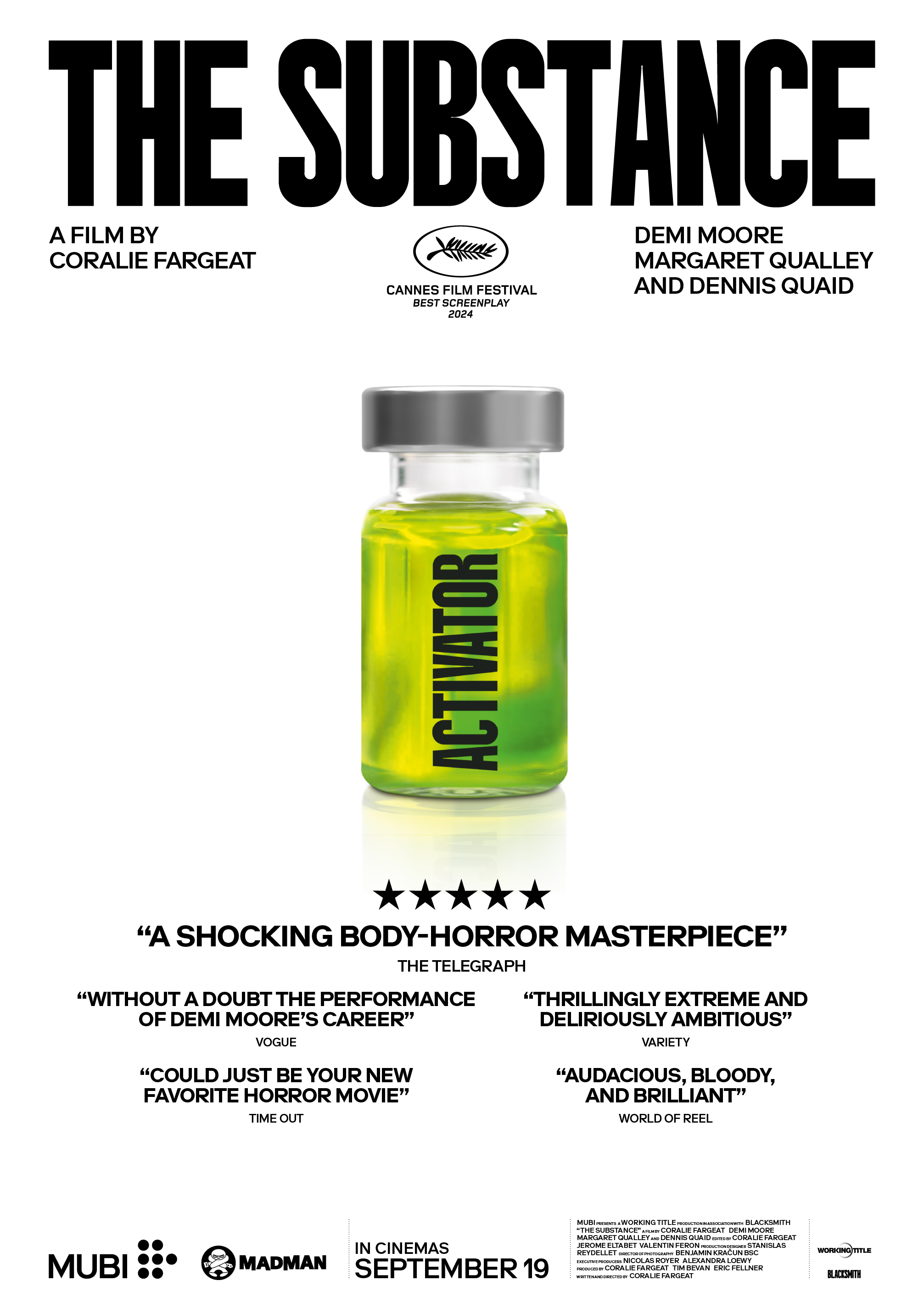
For starters, Demi Moore is back and better than ever as Elisabeth Sparkle, an ageing film star turned exercise video icon, who faces her fiftieth birthday with the knowledge that her producer, Harvey (Dennis Quaid), is looking to replace her with a younger model. Her day only seems to worsen when, in a distressed state while driving, she gets T-boned by an oncoming car. However, in a stroke of luck, she not only survives without a single scratch but, when a young male nurse deems her suitable, she is given the opportunity to try the titular “Substance”. Which, when administered, splits the user into two halves; an original “matrix” and a younger, better “other”. While controlling her other body, played by Margaret Qualley, Elisabeth, now rebranding herself as Sue, decides to take back her idolised position at her former studio. However, when her lenient adherence to the strict rules of the Substance program leads to a splintering of her once singular personality, Sue and Elisabeth fight for control over the life they share, all the while unaware of the ensuing destruction that will inevitably crush them both.
While the script isn’t exactly subtle in its depiction of Hollywood’s control over the lives of its actresses and our obsessive need to course correct the ageing body, the film’s mastery of escalation is what sets it apart from plain old bargain bin schlock. First, the film primes us for gore by painting food with the same grotesque brush. Italian pasta sauce slops onto Elisabeth’s star on the Hollywood Walk of Fame as a passing patron tries to wipe it off with his foot, chicken is ripped apart and splattered on cutting boards, and mixers spatter and churn lardy fluids. A lunch scene with Harvey is particularly nauseating. We find him finger deep in a blow of prawns, saliva and sauce clinging to the tablecloth in front of him. He picks one unlucky yet girthy one from a pile of half eaten carcasses. And as we sit, literally spitting distance from him, he picks it apart while slobbering excuses to Elisabeth regarding why she has to be let go. Before even a drop of blood is shown, Fargeat uses squelchy sound design and extreme close-up camera work to elevate the people and food around Elisabeth into pure abominations, making many in the audience like myself dread what actual horrors might be in store.
While it doesn’t properly happen until Elisabeth and Sue’s personalities fully fracture, Moore and Qualley play off each other beautifully. Moore imbues Elisabeth with this Frankenstein level hatred for her creation, while Qualley embodies the brattish youth of a Dorian Gray type, who, haunted by the spectre of her past, chooses to hide it from view, even making DIY modifications to conceal Elisabeth’s body behind a fake bathroom wall. When either woman has their unconscious body dragged through the halls of the apartment, as heads bang on stairs and legs and arms are flung around, the film becomes slapstick in its physicality. And while the animosity for each other is played up to great effect, you can immediately tell how fun those scenes must have been to perform.
Now, there is an argument to be made, if it has not been made enough already, that the objectification of the main characters, despite being placed under an incredibly large satirical lens, could be distasteful. And it’s easy for proponents of the film like myself to shove these criticisms aside with the pithy and simple fact that Fargeat is a female director portraying the ridiculousness of the male gaze. However, an identity does not absolve you of mistakes. I think we all remember the Cuties discourse of 2020. Despite director Maïmouna Doucouré’s pure intentions to highlight the sexualisation of young girls in both dance competitions and pageantry in general, she employed the same exploitative filmmaking techniques that she abhorred, and, in so doing, allowed the film to foster an audience which benefited from that very same exploitation. So, is it possible that while not as egregious as Cuties, The Substance engages in the same level of exploitative filmmaking?
I would argue no. As Cuties suffers from depicting its abuse with a brutal realism that doesn’t attach itself to anything except a meek disavowment, in contrast, The Substance makes the ridiculousness of the situation abundantly clear. When Sue has one nightmare of an arse malfunction during an exercise shoot, the camera operator zooms in to a comical degree as crew stand around the monitor, gaping at Sue’s rear like the monkeys gathered round the obelisk in 2001: A Space Odyssey. The desires of men, and more specifically misogynists, are ridiculous and should be treated as such. Great satire doesn’t just show you horrible things and expect you to automatically be on the side of the victim, it argues with the content you’re seeing on screen. It shows you the ghost, and heightens it to the point where you see it for what it really is: the child under the bed sheet. I imagine Moore, whose name and age have been dragged through the tabloids ever since her 1991 Vanity Fair photoshoot, and later, her relationship with the much younger Ashton Kutcher, was revelling in the chance to make a fool of those neanderthal execs who had a hand in tarnishing her image.
After all, the “Substance” like any real world pharmaceutical – from skin creams to pregnancy pills – was created for the sole purpose of helping women control what men could not, even if it puts those same women in harm’s way. Unlike Divinity from last year, which childishly explains away a youth serum’s popularity to a societal hedonism, the “Substance” is a tragic and painful prescription born from an emergency. The women of Hollywood may sometimes seem vain on the surface, but as Fargeat is eager to remind us, the same women are ultimately trying to survive in a world ready to chew them up and spit them out on the pavement next to all the other faded stars.
The Substance can be seen in cinemas now, after recently screening at the Melbourne International Film Festival aka MIFF. Interested in writing a review of anything in exchange for a free ticket? Just fill out this form or send us an email at unimelbfilmsoc@gmail.com. For more info on MIFF, including how to become an Under 26 Member for $25 and get access to complimentary year-round preview screenings, head to the MIFF site here.
 MELBOURNE UNIVERSITY FILM INQUIRER