
Who Do We Get to Be?
By Adeline Williams
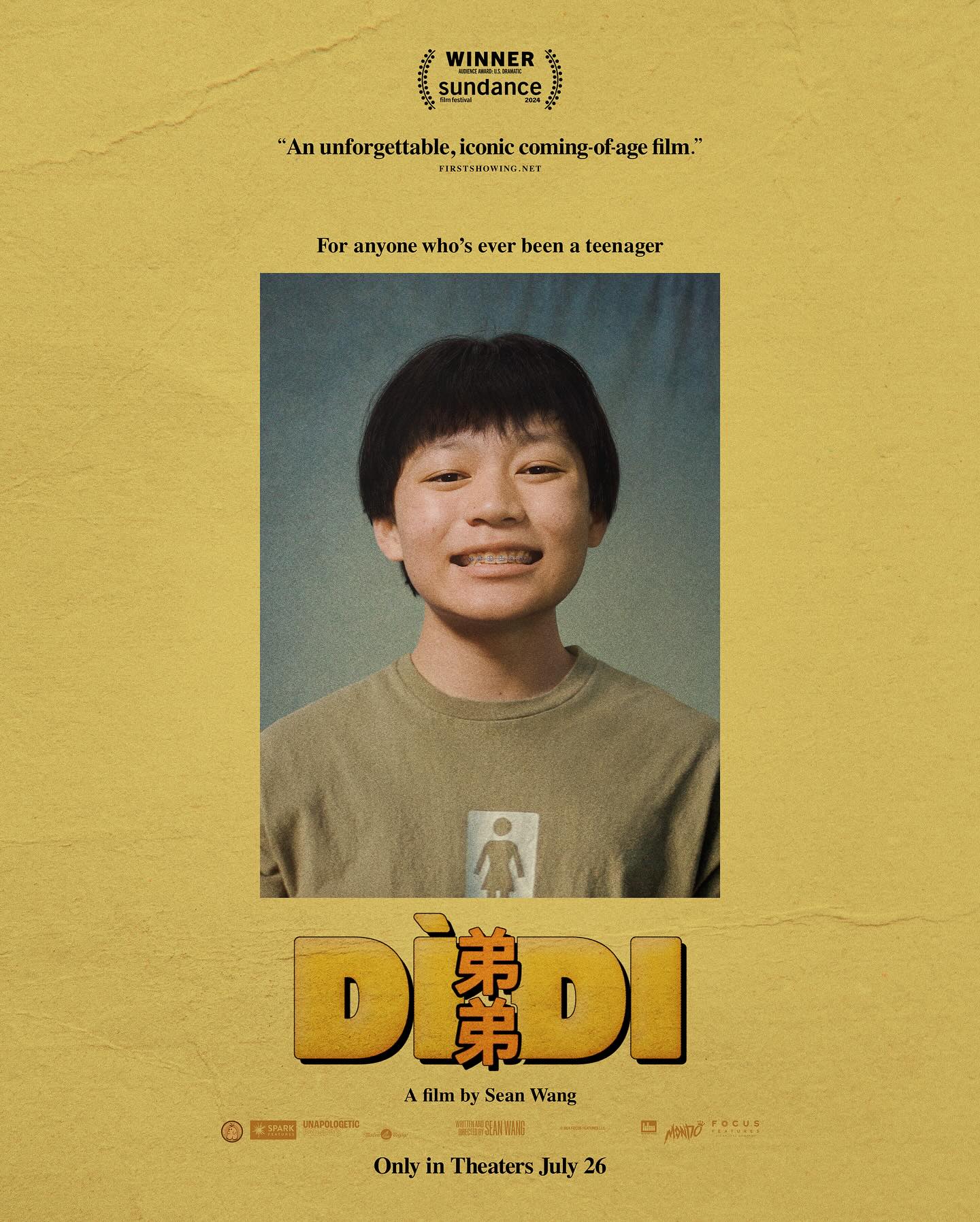
Last week, I was able to watch the comedic yet heartwarming coming-of-age film Dìdi by Sean Wang. The movie touches on themes of identity, race, and growing up in the digital age. Set in the late 2000s in California, the story follows Chris Wang (played by Izaac Wang , no relation to the director), a thirteen-year-old Taiwanese American who is struggling to find out who he wants to be.
The film opens with the laughs of young teens and a mailbox that is about to explode due to a prank. In the shot, we see Chris laughing hysterically while sprinting for his life. He later uploads this to his YouTube Channel where we can see other other videos of him pranking his friends, trying to learn skate tricks, and even one where he is dancing with his grandma, Nǎi Nai (played by Zhang Li Hua, director Sean Wang’s actual grandma). The film feels very nostalgic from this get-go and made me feel as though I had been transported back not only to the 2000s, but also to the age of 13 – from the shaky camcorder shots, to the ways in which the characters interact with each other. For example, when Chris meets up with his friends, one of them pulls a “yo mamma” joke and the rest chime in to try and one up the others in their comebacks. The frequent use of close camera shots meanwhile makes the story seem all the more personal. One myself and many others reacting to the film have been able to form a connection to as we see our younger selves in these characters.
Throughout the film we see how Chris moves throughout various identities depending on who he is around. When around family, he is “Dìdi” aka “little brother”, with friends, “Wang Wang”, and to strangers or people he wants to impress, just “Chris”. This subtly reflects the inner conflict with Chris’s Asian American identity. As a second-generation immigrant, he is consciously aware of “how Asian” he is around non-Asians, specifically white people. This often causes tension between him and his mother (played by Joan Chen), who has accented English and tends to only speak Mandarin, which in Chris’s eyes makes her “so Asian”. In trying to seem “cool” he pretends to like the same movies and music as a girl in his grade, and even introduces himself as Chris instead of his more Asian and childish nickname. We really see how much being Asian affects his confidence when they are on a date and the girl makes the comment that he’s pretty cute “for an Asian”. Throughout the film, we also see how Chris tries to navigate his middle school friendships as they transition to high school, often feeling left out. It’s here where Chris lies again in order to impress a group of older teenage boys that like to skate, saying that he is “half-white”.
All of these themes of identity and code-switching really hit me. As an Asian American myself, I remember not wanting to be known as “The Asian One” in my primarily white school. Even worse, I didn’t want to be known as the “Weird Asian”, so I would adopt whatever thing was popular at the time in order to fit in. Like Chris, I often fought with my mom thinking that she didn’t understand the nuances of my friend groups and why I NEEDED a snapchat account to be considered cool.
The theme of family is also very poignant in the film as it is a big part of most Asian cultures. With Chris’s sister leaving for college, the pressure for Chris to be “the man of the house” is thrust upon him essentially overnight. However, for me, the relationship between his mother and paternal grandmother was something that as an Asian woman I felt much more connected to. We get to see how Chris’s mom, Chungsing, and her own mom aren’t perfect either. The ways in which Nǎi Nai is overbearing are often presented as comedic, but over the course of the movie we are able to see how much her comments affect Chungsing. I think this speaks to how when we get older we start to notice how much sacrifice our parents go through, and at some point start to see them more as people with their own lives.
To me, the movie felt like it was just a small part of a larger story in a good way. I felt as though I got a look into someone else’s life, which is a testament to how personal Sean Wang makes this semi-autobiographical story feel. By the end of the movie Chris is more grounded in who he is, which is only possible through his mistakes and mishaps. Something we can all relate to.
Dìdi recently screened at the Melbourne International Film Festival aka MIFF, with a wide release date in Australia to be announced at a later date. Interested in writing a review of anything in exchange for a free ticket? Just fill out this form or send us an email at unimelbfilmsoc@gmail.com. For more info on MIFF, including how to become an Under 26 Member for $25 and get access to complimentary year-round preview screenings, head to the MIFF site here.
 MELBOURNE UNIVERSITY FILM INQUIRER