By Johnny Hill
Body-horror auteur David Cronenberg does not seem concerned with whether an audience understands his films. Instead, he seeks to maximise the intersection between technology, the body and violence, whether or not what is occurring actually makes sense. In Videodrome (1983), Cronenberg crafted a visionary tale that highlighted the insidiousness of readily available violence in screen media through absurd bodily transformations. Crash (1996) was no different, except in its transforming of that violence into a kind of truly mechanical sexual release.
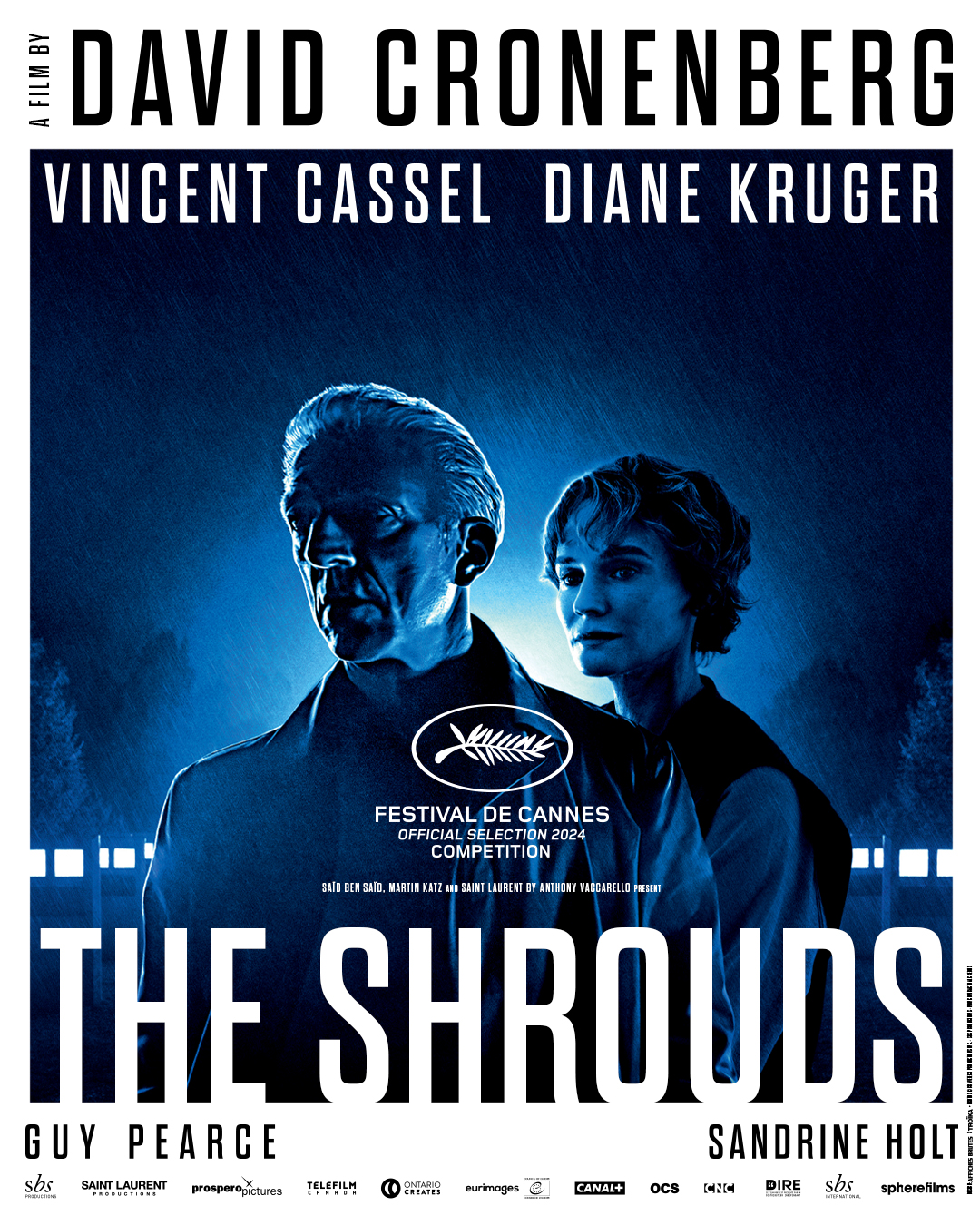
It is no wonder then that his latest film, The Shrouds, also sacrifices a comprehensible plot in favour of showing the impact of technology on humans. Except, rather than being focused on gruesome bodily modifications or over-the-top violence, The Shrouds is perhaps as sensitive as a body-horror film can be, with Cronenberg translating his usual shock into a melancholic story about grief and the nature of loss. Cronenberg opts instead to show what happens to the body and those who once knew it after it dies – a 180 reversal from the still-alive modifications present in his last effort Crimes of the Future (2022). Wrapped up in a paranoiac and AI-tinged fever-dream of a plot, The Shrouds is Cronenberg’s reckoning with what happens when the world moves past you, people die and technology progresses, leaving you in their wake. It is through this that the feverish plot works, as it elicits the same feeling as watching the environment you once had control of slowly move itself out of your grasp, despite your best efforts, leaving you floundering as it seeks to instead control both your mind and body.
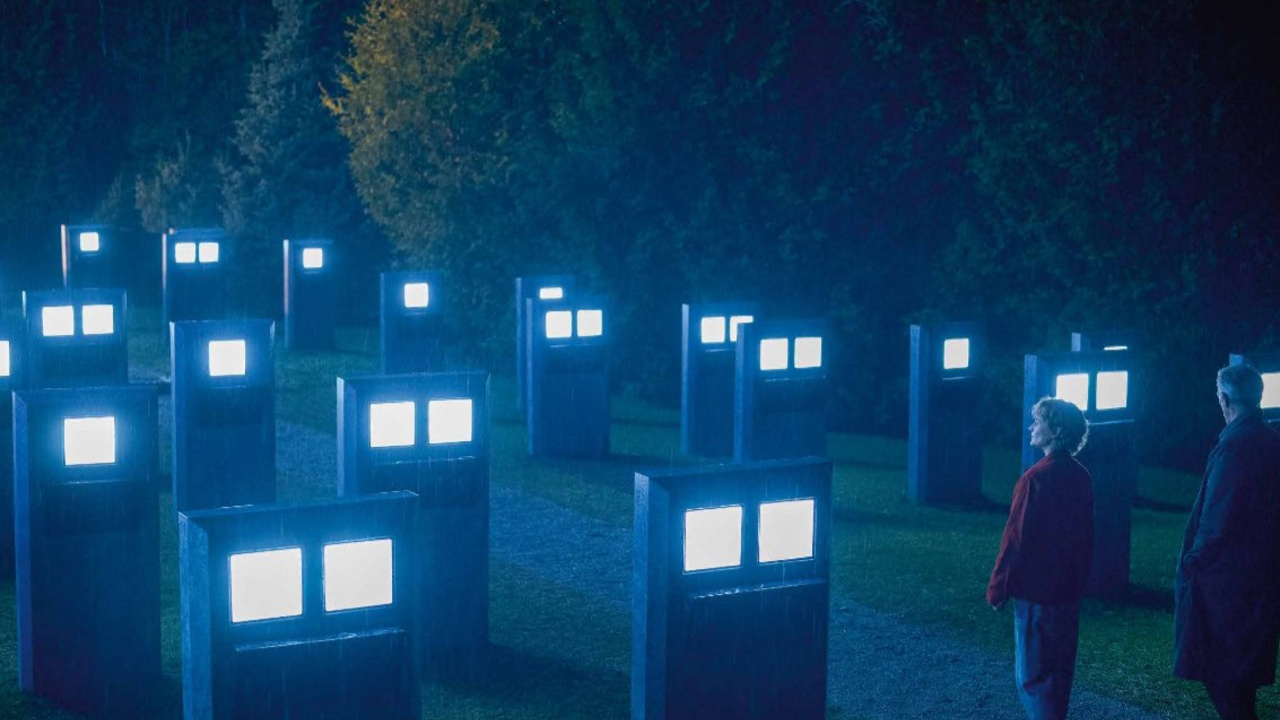
Throughout The Shrouds, we follow Karsh, a businessman that is supposedly “rotting” from grief after the death of his wife. Because of this grief, he invents GraveTech – a technology that places a screen into the gravestone of your beloved and allows you to watch a live feed of their corpse, donned in black “shrouds” that allow for a full 3D view. A premise only David Cronenberg can come up with and remain serious about, despite some darkly humorous moments throughout the film. Cronenberg seems to understand that grief can take many forms and, thus, does not seem to think it too weird that Karsh has a constant live-feed of the rotting corpse of his wife in his home at all times, despite what anyone else may think.
Played by Vincent Cassel with combed back silver hair, a stand-in for Cronenberg himself (who is no stranger to inserting himself into his films, just see 2021’s The Death of David Cronenberg co-directed by him and daughter Caitlin), Karsh is both a man suffering from grief and an egocentric and stoic tech entrepreneur, dressed sharply in costumes created by Saint Laurent, who also produced the film. On the other hand, Karsh’s dead wife and her twin sister are both played by Diane Kruger, who gives a great and strange performance as the conspiratorial sister-in-law Terry.
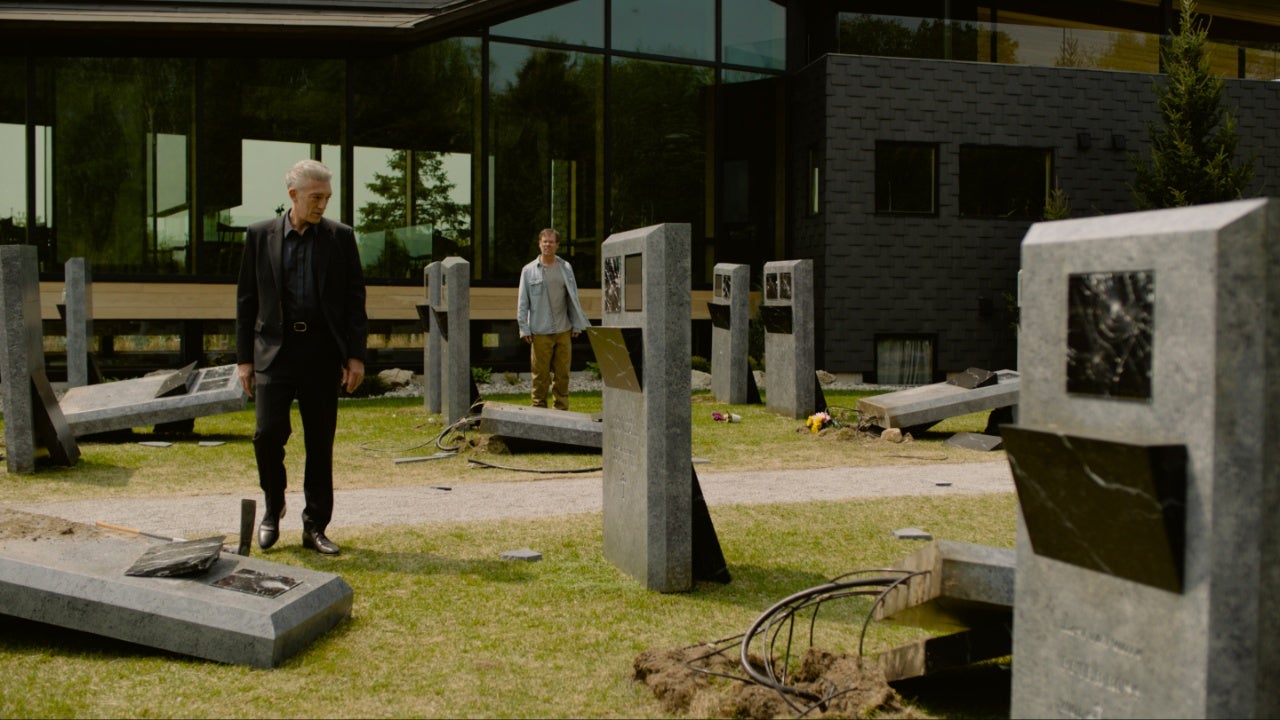
After GraveTech’s graves are vandalised, the film kicks fully into a story of paranoia and conspiracy. Much like the notion of grief itself, The Shrouds has little clarity in what it portrays here. Every new clue in the film opens a new path that never seems to resolve. Whilst this does sometimes give the impression that Cronenberg simply did not know where to go with the story, it also effectively replicates the nature of technology’s influence in the modern day. Across millions of screens, news is broadcast that blames a foreign entity for no reason while forum posts proclaim truths with no basis. It is easy to get sucked into believing these distracting falsities, Cronenberg seems to warn, when the influence of technology is so far widely spread. Rather than not knowing where to go, Cronenberg seems to want to provide the film with a purposeful sense of uneasiness and aimlessness, much like one feels when technology outpaces us.
Instead of logical progression, Cronenberg’s film is carried by a constant feeling of fear and grief. It is a dark film, both literally and metaphorically, with many scenes taking place in the night, providing it with a moody sense of melancholy. The best scenes in the film, in fact, are those that take place in Karsh’s nightmares – a form of sleep paralysis where he is trapped in his bed and watches his wife’s body slowly disintegrate due to experimental surgeries. These scenes strikingly convey the feeling of watching a loved one slowly become unrecognisable, highlighting Cronenberg’s tenderness in regard to this tragedy whilst also being an interesting display of the body-horror he is best known for.
It is this constant reminder of grief that also imbues The Shrouds with a cold stiffness and repetition. Nothing really seems to go anywhere – Karsh’s attempts to move on lead him back to where he started and everything is a reminder of what has already occurred. Technology and the people around Karsh seem to mock him, keeping him in stasis and leading him to make mistakes that cause his descent back into the void of grief, rather than assisting him in moving on.
While many strange and seemingly out of place scenes exist in the film, Cronenberg effectively elicits the strangeness and the foreignness of grief that transforms one’s world into one of coping and disorientation. Although one may be put off by The Shrouds at first watch, I believe it is an enlightening experience that can slowly pervade one’s psyche after pondering its weirdness for days – something only Cronenberg films seem able to do.
The Shrouds recently screened at the Melbourne International Film Festival aka MIFF, with a wide release date in Australia to be announced at a later date. Interested in writing a review of anything in exchange for a free ticket? Just fill out this form or send us an email at unimelbfilmsoc@gmail.com. For more info on MIFF, including how to become an Under 26 Member for $25 and get access to complimentary year-round preview screenings, head to the MIFF site here.
 MELBOURNE UNIVERSITY FILM INQUIRER