
By Johnny Hill
A quiet terror pervades each scene of Bertrand Bonello’s The Beast. It is the fear of the titular concept – an intangible presence that stalks Gabrielle (Léa Seydoux) and Louis (George MacKay) throughout multiple timelines. Because of it, Gabrielle’s corresponding incarnations constantly grapple with a feeling of impending doom, whilst Louis struggles with a lack of connection caused in part by Gabrielle’s fear of the Beast. Through linking this notion of doom between 1910’s bourgeois Paris, 2014’s modern Los Angeles and 2044’s desolate near future ruled by unfeeling AIs – a framing device in which Gabrielle undergoes a process of jumping back in time to remove her past emotions – Bonello crafts an ambitious and sweeping film that touches on the universality of fear and its consequences for human connection.
This effortless interlacing of three separate timelines is where Bonello’s film excels. Influenced by Henry James’ 1903 novella The Beast in the Jungle, Bonello crafts an anxious environment where every timeline grapples with their own cloaked form of unchecked fear. Despite the first story occurring in turn-of-the-century Paris, it is this underlying thread, even more so than sci-fi time travel, that makes Bonello’s film feel so modern – especially in an era where people more and more seem to have to grapple with the fear of unseen threats such as climate change and the polarisation of politics. Whilst films such as Michael Haneke’s The Seventh Continent have handled this idea already, Bonello’s also reconciles fear with humanity, contrasting the two earlier timelines with the future to show that, although fear can cripple and hinder relationships, it is also necessary to be human.
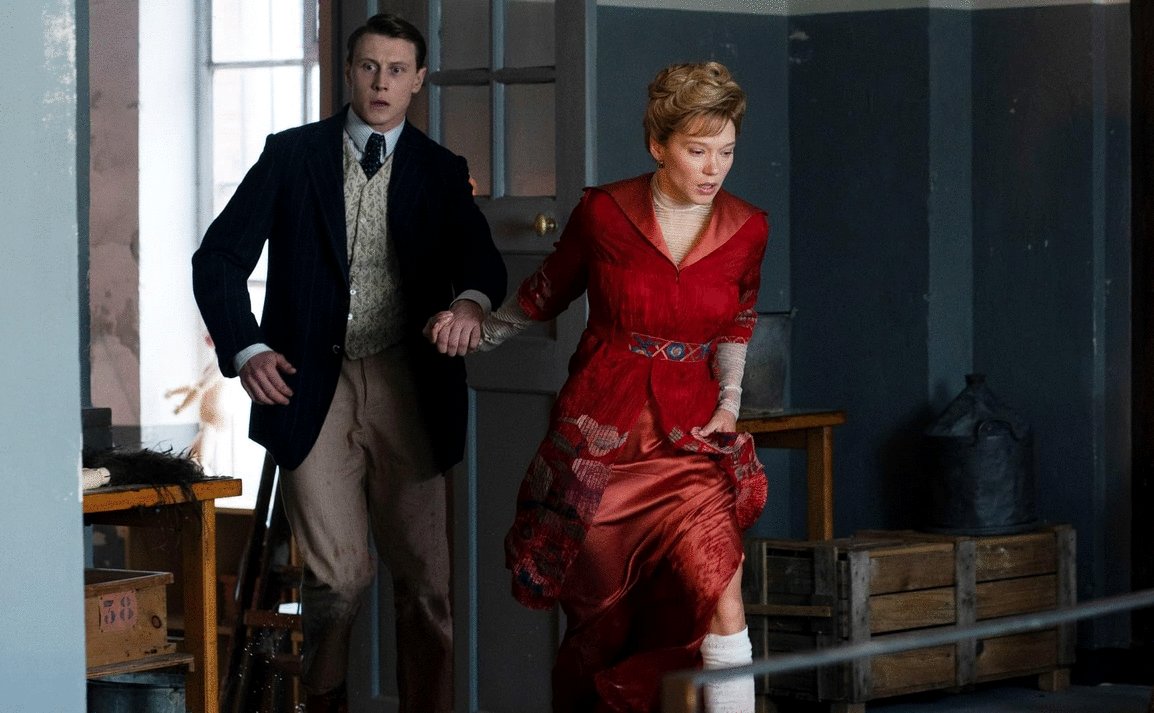
In 1910, then pianist Gabrielle fears the Beast, the incoming Paris flood and the doubt of having married the wrong man. Old acquaintance Louis, meanwhile, attempts to connect with Gabrielle in any way he can, seeking some other sort of emotional response. Despite this, Gabrielle keeps them apart, with her slowly sinking into a more unstable fate because of her inability to move past fear. Through this Bonello states the main thesis of the film – the crippling nature of fear – but he also foreshadows how the inverse of removing all emotion is even worse, leading one to become a blank-faced doll much like the ones Gabrielle’s Parisian husband crafts – ones also liable to catch fire and burn down.
The next continuous story is that of 2014 Los Angeles. In this era Gabrielle is an aspiring actor, performing alone in front of green screens where she has to pretend to be scared of something; even being hit by an invisible car for a phone safety PSA – an apt metaphor for Bonello’s main theme. Acting alongside the figurehead of jaded modern society Dasha Nekrasova, co-host of the Red Scare podcast, both Seydoux and her depict a modern malaise – with the Beast being made up here by the fear of loneliness in modern society.
On the other hand, George MacKay’s 2014 Louis is instead a sinister recreation of real life incel murderer Elliot Rodger. As we follow Louis around, he repeats word for word Rodger’s online manifesto about how he “deserves women” and how seeing others in a relationship makes him sick as he believes every woman is out to make him remain a virgin. This chapter significantly ramps up the tension, turning a story of doomed love into a story of how one is able to easily slip down the pipeline into inceldom through believing that their emotions are immovable and nothing will ever change. Whilst Gabrielle is now stalked by a very real physical manifestation of the Beast, Louis shows how one can become the Beast itself with enough delusion and separation from emotional reality.
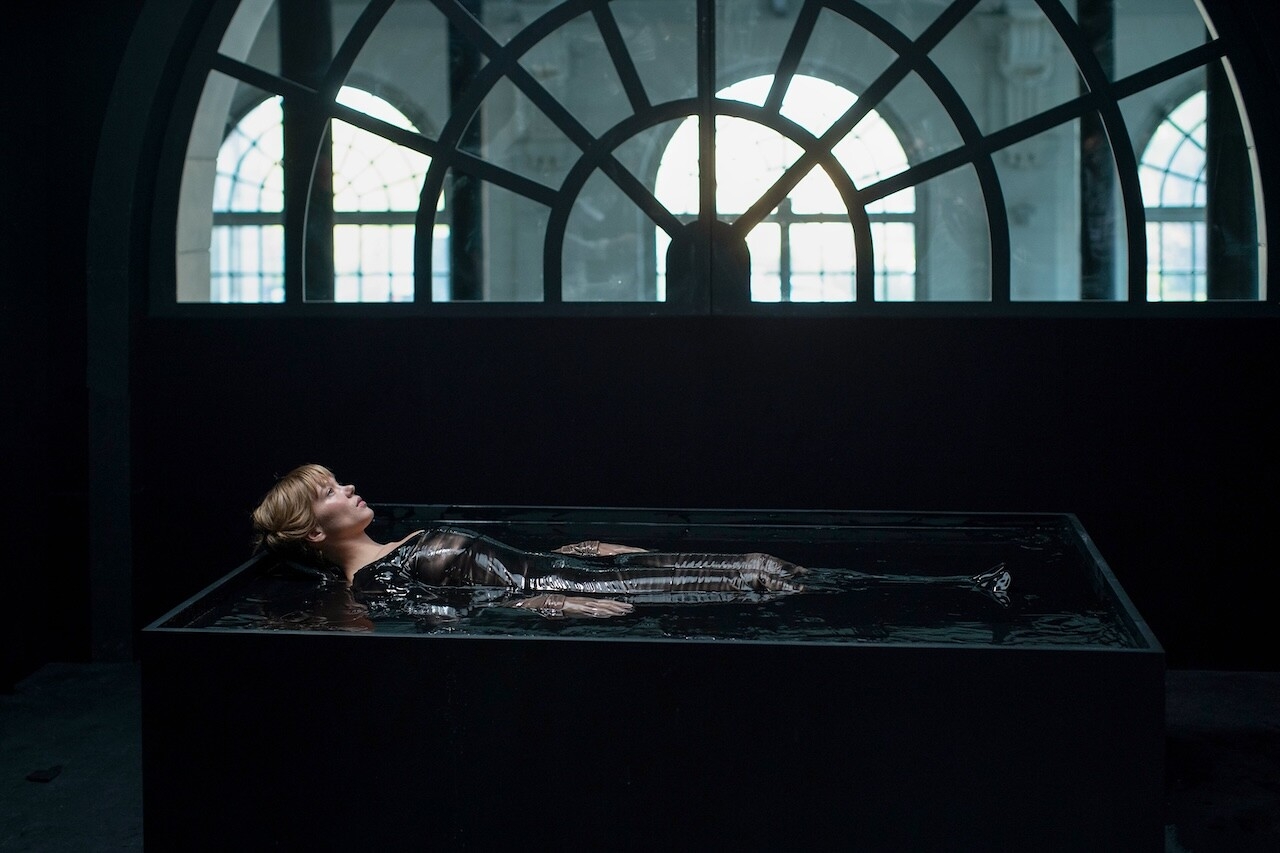

Finally, Bonello transports the audience to 2044. Featuring a colour palette of greys and browns, Bonello’s 2044 is one that has succumbed to the Beast, one where people live in blissful ignorance of emotion and find escape in simulated places of past eras. It is this timeline where Bonello makes his most grand statement: that although the Beast stifles our humanity and ability to connect, it seems inhuman to live without fear as well.
Each of these stories weaves and connects to each other gracefully through a web of repeated symbolism and repeated lines, crafting a sense of mysticism and universality to the film. Through this, Bonello portrays how the past encroaches on the present, and how humans will continue to fear and never form true connections if they do not accept the Beast for what it is – an impalpable fear, constantly present for centuries.
Moreover, Bonello’s film is truly modernist in the way it depicts technology, its filmic language being one of cool, static shots that blend the real and virtual, including through the creative use of security cameras and green screens that emphasise the lifelessness of humans captured by fear and emerging automation. In 1910, the piano and the terrifying pieces of Schoenberg manifest Gabrielle’s fear. In 2014, it is the Phone, used to vlog and rant on the expansive internet that accepts whatever hateful words you spew. In 2044, it is the eventual culmination of completely trading human emotion for expression through technology or the allure of convenience – a life automated by indifferent, ‘intelligent’ dolls. Bonello thus warns of reliance on technology and other escapes, stating that this does nothing to truly turn away the Beast. Much like in the film’s creative opening scene, we are instead blurred and torn apart by tech, rather than becoming whole.
Whilst The Beast does eschew its surreal nature at the end for an on-the-nose gesture, it still provides an affecting look into the nature of humanity and emotion, propelled by the continuous chemistry of Seydoux and MacKay, who truly convey a modern notion of doomed lovers. Although there is much to fear and there has been for centuries, Bonello’s film also paradoxically provides a light at the end of the tunnel for humans, crafting a dialectical film that through its depiction of detachment and its inverse may provide an enlightening, emotional release to viewers. Much like Henry James’ proclamation that it is a “failure not to be anything,” Bonello shows the danger of trying to turn away from the Beast, simultaneously posing a lasting question to the audience that reveals its answer in the folds of the film – how will you deal with the Beast in the jungle if, and when, it strikes?
The Beast can be seen in cinemas now, or at home through a variety of video on demand services.
 MELBOURNE UNIVERSITY FILM INQUIRER