By Alexander Martin
The old “show, don’t tell” aphorism is simple but fundamental. Perhaps in some part it’s an indictment on me, but I’ve become increasingly bored by overly expository dialogue; with characters who expound their feelings, pasts, and motivations as though reading from their own Wikipedia entries. There’s something to be said about a film that provides only glimpses into its character’s inner worlds, or what I call ‘character moments’, allowing the audience to either infer the rest from actions, reactions and dialogue, or fill in the blanks with their own imagination. It involves a certain level of skill, in that characters must then act in a manner transparent enough to make their motivations clear, but not so transparent as to become superficial. It also involves trusting the audience to properly appreciate actions and events as they unfold, without holding their hands through unnecessary exposition. Most importantly, it elevates a film by allowing us to view its characters as complex individuals with unique emotions, motivations, and values not easily summarised.
A film that illustrates this incredibly well is Doug Liman’s The Bourne Identity. It does so because, but for one scene especially, it would be a standard, if influentially stylish, action film: well-made and entertaining, but superficial. The scene I refer to is the death of the CIA Operation Treadstone agent known as ‘the Professor’. Prior to this scene, he appears your typical assassin: cold, calculating, and a man of few words. However, upon being mortally wounded by the titular protagonist, we are allowed a glimpse beyond this persona. He admits that he, like the other Operation Treadstone agents, is utterly alone. When Bourne questions him further, he responds only with telling questions of his own, not as a means of deflecting interrogation, but in an effort to connect with someone in his dying moments. Before finally dying, he says, with a mixture of regret and melancholy: “Look at what they make you give.”
In a film that is otherwise focused on action, espionage, and conspiracy, this brief but poignant scene adds incredible depth. Our eyes are opened to the cost of the life these people lead. It prompts the audience’s imagination because we get the sense that the Professor’s not just talking about dying for the job, but also about having misspent his time alive. For example, consider the first time we see him, where he’s teaching a boy to play the piano. Is this his son? Was he referring to his regret about not having spent more time with him? The later scene recontextualises the rest of the film because it forces us to acknowledge that, whilst the film is (and is intended to be) entertaining, its events extract a heavy and mostly unstated toll on the characters. Importantly, this depth could only have been achieved through this character moment. Had the Professor revealed nothing, we’d just take his death for granted; another action movie antagonist succumbing to the hero’s superior abilities. Had he spoken at length about his pain and sacrifices, it would’ve cheapened the entire moment, turning it into a clumsy attempt to insert melodrama into a grounded action film. Excessive exposition creates superficiality, turning complex characters into flat caricatures where nothing is left to lie below the surface.
I highlight this example not to say that every film which provides character moments will necessarily have the same effect or will necessarily have to do so in the same way. The Bourne Identity’s use of the technique and its corresponding effect is unique to it. Indeed, it’s also an action film; a genre not readily conducive to lengthy character exposition (though many include it, and are worse off for it). What is specifically needed will depend on the particular film and the genre within which it exists. What this example does highlight, however, is the potential potency of these moments.
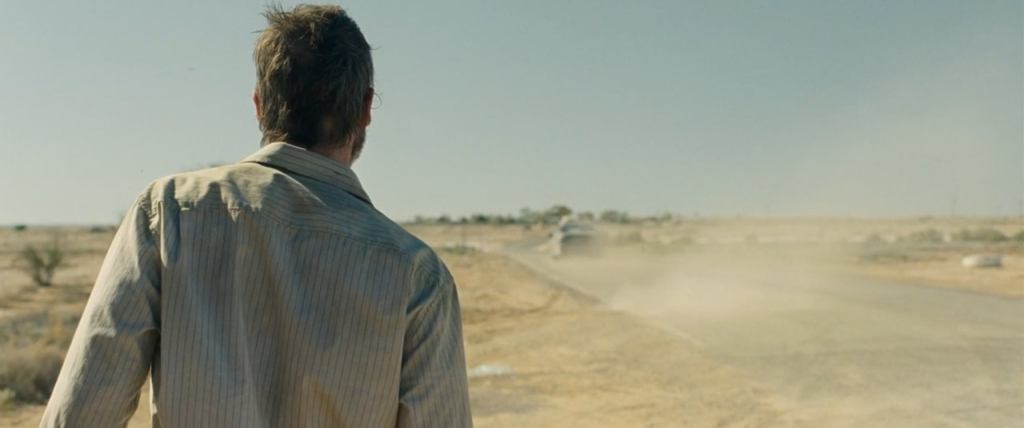
This also isn’t to say that lengthy exposition should be avoided at all costs; not every instance of a character talking about their feelings and life for a few minutes is without value or unnatural. In fact, it has the capacity to be as potent as more restrained character moments. An example that comes to mind is in David Michôd’s The Rover. Set in a post-apocalyptic Australian outback, the film follows Eric as he tries to get his car back from a group of thieves. Eric is hardly a sympathetic protagonist; he’s brimming with a barely contained rage that seems ready to unleash with every word he speaks, he ostensibly cares little for others, and he murders without hesitation. One might reasonably chalk all this up to necessity; the old trope of the post-apocalyptic protagonist hardened by the world. However, towards the end of the film, after being captured, he confesses to a soldier that it “was over a long time ago” for him, when ten years prior he discovered his wife had been unfaithful and he murdered her and her lover. He confesses as much with a deep and uncharacteristic sadness, expressing regret that no one ever came after him for his crime. This relatively extended but still contained episode of exposition thus ultimately conveys a similar effect to the Professor’s scene in Bourne. It recontextualises and ultimately bolsters the film by allowing us to see that Eric’s aggression isn’t just a means of adaptation to the world, but an expression of profound guilt for his crimes, and anger at the world for its indifference not only towards his wrongdoing, but for all the other violence and tragedy that has ensued.

Given my earlier advocacy for restraint in dialogic character exposition, why does this example work? Firstly, because it’s believable. Eric has carried his guilt (and escaped punishment) for over ten years, so it’s entirely feasible he’d use his capture as a chance to confess. Secondly, because it’s the only time in the film he’s this open; it’s a cathartic moment, and we’re drawn to his words because he otherwise says so few. Finally, because it’s necessary: including this backstory bolsters the film, and the best way to include it is through dialogue (a flashback would be tenable, but I doubt it would have as potent an effect).
Both restraint and indulgence in character exposition can elevate a film in similar, if not identical, ways. These two points aren’t necessarily mutually exclusive. If I were to distill any general principles from my above discussion then, it would be this: as with any ‘rule’ governing creative works, “show, don’t tell” shouldn’t be rigorously adhered to, but is rather a guide intended to preserve the potency of exposition. Exposition is a valuable resource, but its value is derived from its scarcity. Characters should reveal only so much as is necessary to allow the audience to appreciate them. Revealing too much risks superficiality, poorly done melodrama and, ultimately, boredom. Often it will be sufficient for characters to implicitly convey their thoughts and feelings through their actions and words, rather than outright describing them, though there may be exceptions. These cathartic exceptions may broadly depend on cohesion with the plot, the amount of exposition already present, and the availability of alternative means of conveying the information. Perhaps, then, the rule isn’t not to tell, but rather to tell only when it’s worthwhile to.
For further thoughts on the power of subtlety and restraint in film, check out Alexander Martin’s other essay, Unanswered Questions: A Brief Discussion Of Enigma In Film. To find out where The Bourne Identity can currently be watched through streaming and video on demand at home, head here. To find out where The Rover can currently be watched, head here.
 MELBOURNE UNIVERSITY FILM INQUIRER