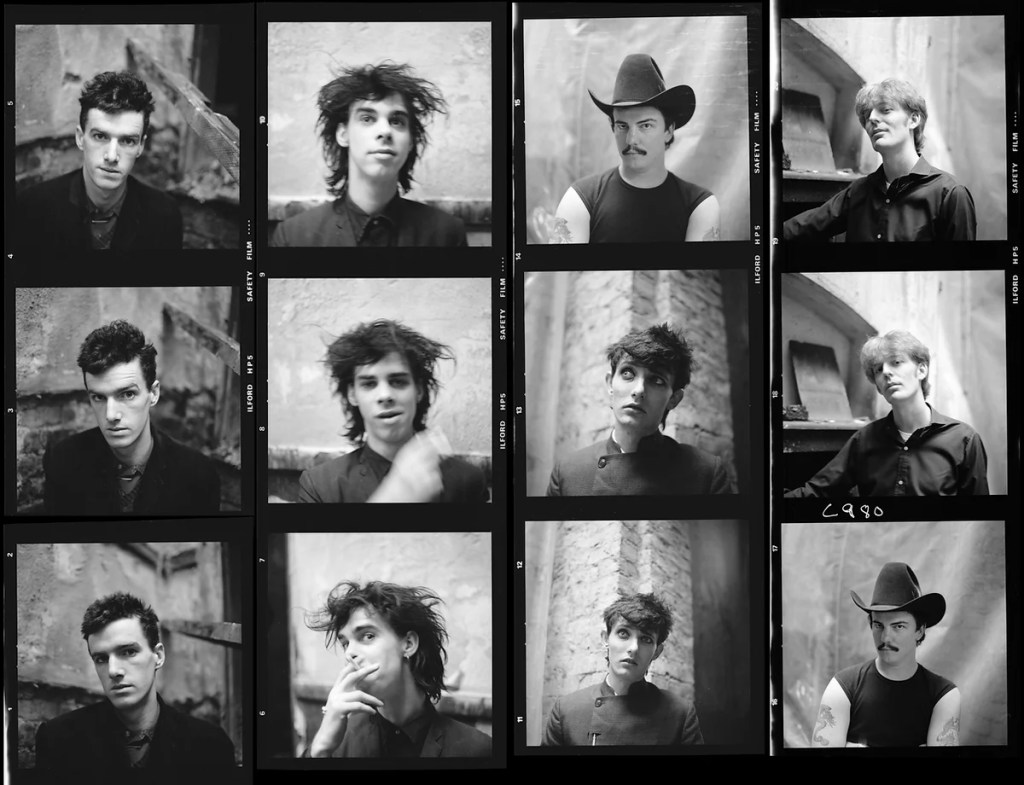
By Dahlia D’Onghia
It’s the 9th of June 1983 and The Birthday Party are playing their final show at the Seaview Ballroom (formerly the Crystal Ballroom) in St Kilda. Amidst a torrent of harrowing screams, erratic electric guitars and a stirringly tribal drumbeat, no one knows this night will come to signify the beginning of the end of the most significant music moment in Australia: the punk movement. As the final chords of Hamlet (Pow, Pow, Pow) ring out, the police sirens and drunken screams of late-night Fitzroy Street traffic pierce the air as the room descends into metaphorical darkness. The show is over.
Today, the Seaview Ballroom is no more and St Kilda is a culturally dead zone. Only Nick Cave, ‘the international star’, Mick Harvey, ‘the sober one’, and Phill Calvert, ‘the one that got kicked out’, from The Birthday Party have managed to survive these last forty years. Yes, these past four decades have brought with them some wonders: the introduction of CDs, the Internet (our holy grail), Rowland S. Howard’s solo albums. And some not so wonderful things: the blasphemy of Nick Cave going mainstream, the Internet (soon to be our downfall), the closure of so many iconic Melbourne music venues, and the fashionable phenomenon of the Australian punk documentary.
The latest in this trend is Ian White’s Mutiny in Heaven: The Birthday Party, which premiered at the Astor Theatre as part of the Melbourne International Film Festival on August 12th. The documentary claims to tell the story of The Boys Next Door/The Birthday Party’s ‘ascent, apex and inevitable collapse’, through unseen footage and interviews, original animation and some obligatory talking heads. It is loud, abrasive and by all surface appearances seems to embody an energy that will make you wish you had lived through Melbourne’s punk heyday. However, upon closer inspection, you need not look beyond the title of the film to see its fundamental flaw.
We all know that a title often has two meanings, the literal interpretation and then the subtext. Literally, Mutiny in Heaven is the title of the final track on the band’s final EP released in 1983. Ironically, however, the track is also one of the few that Rowland S. Howard doesn’t actually play on. At that point in time, he’d already been effectively replaced (both creatively and physically) by soon to be Bad Seed Blixa Bargeld, from German band Einstürzende Neubauten. Despite the inclusion of snippets of interview footage taken not long before Rowland’s passing in 2009, by the end of the film it is clear that his creative and intellectual presence is also profoundly absent from it.
As the title involuntarily reveals, Cave and Howard’s ‘creative differences’, which ultimately led to the band’s demise, were not the innocent parting of ways that Cave would so diplomatically have you believe. When your ego is so inflated that you refuse to sing lyrics penned by Rowland, deeming them ‘too deep’, that is the death of true creativity.
Mutiny in Heaven is an assault on the senses that, if nothing else, captures the chaotic, drug fuelled and at times violent atmosphere that surrounded the band near their end during 1982-83 (I’ve confirmed with my sources – those who actually lived through it – that at many of their final shows this was in fact the case). And if that’s the kind of punk experience you want to have, this film will undoubtedly satisfy. For me though, I needed something a little more abstruse.
I think I’ll just rewatch Autoluminescent: Rowland S. Howard. Now, that’s a documentary you’ll want to see.
Mutiny In Heaven: The Birthday Party recently screened at the Melbourne International Film Festival and will receive a theatrical release in Australia beginning October 26th. Autoluminescent: Rowland S. Howard (2011) can currently be watched on Prime Video, Doc Play and Beamafilm in Australia, or rented through a variety of other services. Interested in writing a review of anything in exchange for a free ticket? Just fill out this form or send us an email at unimelbfilmsoc@gmail.com.
 MELBOURNE UNIVERSITY FILM INQUIRER