By Lilly Sokolowski
Spoilers
For our second review of Past Lives by Amirahmad Azhieh following its wide release, click here.
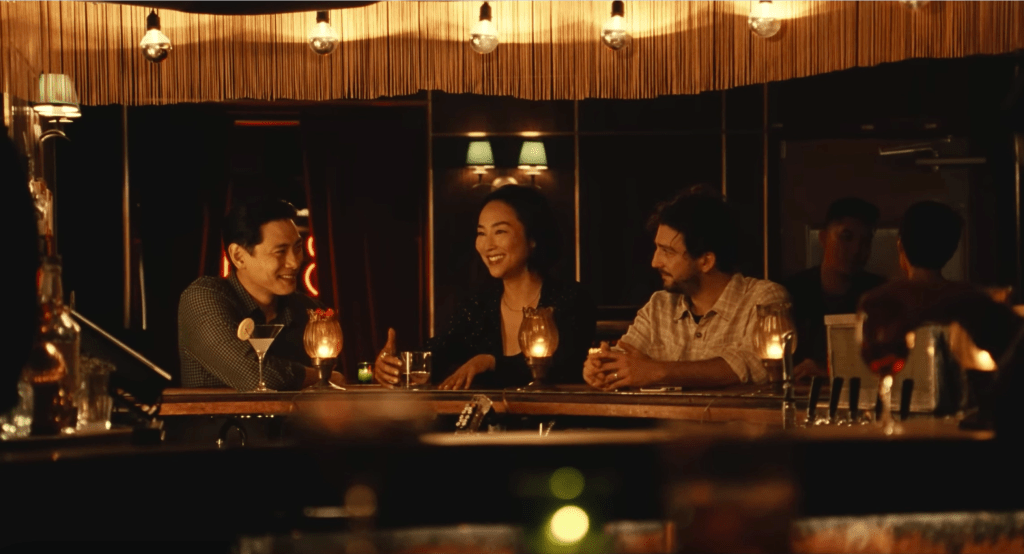
Celine Song’s directorial debut, Past Lives, opens with two offscreen, whispering voices onlooking the film’s three central characters, Nora (Greta Lee), Hae Sung (Teo Yoo) and Arthur (John Magaro), from across a bar. Keeping the audience at this observant distance, the faceless, nameless voices become a kind of surrogate for our thoughts. They are just as clueless as us, wondering who these people are and what their relation to one another is. But the film does not keep us at this distance, as we are slowly lulled into the deep emotional world of it with the help of some amazing performances by its central cast, especially Greta Lee, whose magnetism on screen pulls us in further and further, and emotive cinematography by Shabier Kirchner.
Past Lives follows two childhood sweethearts, Nora, née Na Young, and Hae Sung, who reconnect in adulthood despite the years and distance between them. They grow up together in Seoul, South Korea, but when Nora moves away to Canada with her family at twelve years old, they lose touch. 12 years later, whilst Nora is living in New York and Hae Sung still in Korea, they reconnect via Facebook and embark on a relationship over Skype that not only draws Nora back to Hae Sung but reconnects her to the little girl she left behind in Seoul. It is clear that Hae Sung is not only Nora’s childhood sweetheart, but a vestige of her past life. The film, therefore, is overwhelmed with a sense of diasporic longing. When their relationship, not explicitly romantic or platonic, is cut off by Nora, the characters are once again distanced from not only each other, but who they once were.
The notion of ‘in-yun,’ the Korean term for fate that connects people to one another, permeates Past Lives. When flirting with her future husband Arthur, Nora cheekily remarks that in-yun is “just something Koreans say to seduce someone,” but the film considers this concept earnestly to explore the layers of connection central to the story. Not only connections between people, but to the plethora of past lives we leave behind. When Nora reunites with Hae Sung when he comes to visit her in New York after another 12 years have passed, she is now married, and the layers of connection, fate and yearning are even more pronounced between them.
A standout moment of the film is when Hae Sung and Arthur are left alone at a bar, the one where the film begins, and, despite their language barrier, Hae Sung remarks how he and Arthur, too, have in-yun. It’s an extremely tender and heartbreaking scene, as Hae Sung must grapple with the fact that he and Nora will never eventuate into something more with each other, at least in this life, and Arthur must accept that there is a part of Nora he will never fully understand. It makes Nora and Hae Sung’s parting at the end of the film all the more devastating, and Arthur’s comforting of Nora as she cries all the more affecting. The film is not only about love lost, but about what it means to grapple with what could have been and to let go.
When the film finished at the sold out session I saw it at, you could feel a buzz in the air of the cinema. A kind of quiet awe, for what we had collectively witnessed. A kind of in-yun. Past Lives is not hyperbolic, it does not exacerbate its emotions for audience satisfaction. Yet it is in this gentleness that it succeeds to create a deeply human story that I believe will stay with me for years to come.
Past Lives will receive a wide theatrical release in Australia beginning August 31st, with advance screenings from August 24th. The Melbourne International Film Festival is currently running online through MIFF Play from August 18th until the 27th. Interested in writing a review of anything in exchange for a free ticket? Just fill out this form or send us an email at unimelbfilmsoc@gmail.com.
 MELBOURNE UNIVERSITY FILM INQUIRER