By Chelsea Daniel
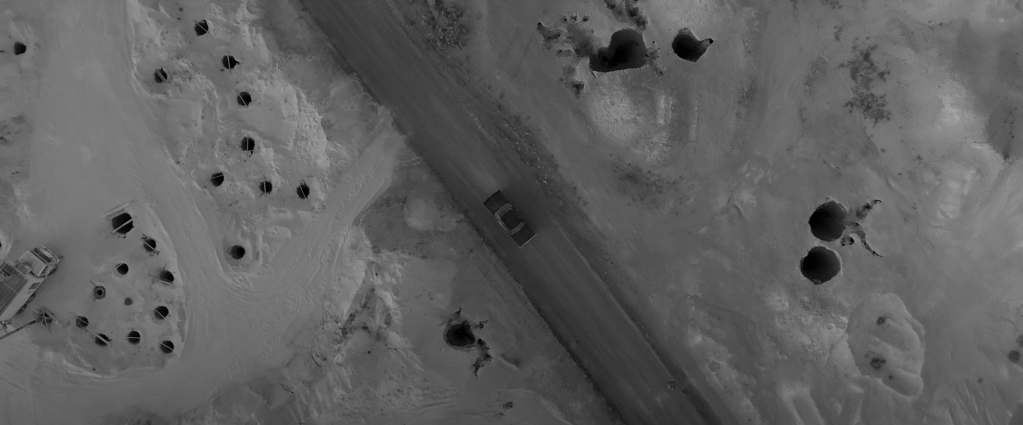
In Limbo’s opening sequence, detective Travis Hurley (Simon Baker) is driving in his Holden, listening to bible parables preached in a Southern American accent. He is driving along a mined landscape, which is on full display in black and white. In this moment, it is hard not to know where the movie will go if you have seen a few outback crime or road films. Every plot point, every character, and even the resolution can be predicted. And while each is delivered well, and Baker’s incredible performance and writer-director Ivan Sen’s creative touch are ever-present throughout the film, it fails to break free from its predictability.
Limbo follows Hurley as he investigates a 20-year-old case of the disappearance and implied murder of Charlotte, an Indigenous Australian girl, in the fictional town of Limbo. When he arrives, he finds Charlotte’s siblings, Charlie (Rob Collins) and Emma (Natasha Wanganeen), and the town in general, still haunted by the devastation of the case and the failures of the justice system for First Nations People. In other words, the case, the characters, the town, they’re all in limbo.
It is hard not to respect the film’s artistry, from Baker’s performance to Sen’s clear history in documentary making and photography. In a Q&A, Sen said the setting, including filming location Coober Pedy’s cavernous churches and the use of a Black Dodge car, came first and the storyline second. The issue is that it made complete and obvious sense when he said this.
The town and film, in its emphasis on style, often lack a subtlety the latter would have benefited from. Hurley stays in the Limbo Motel, underground accommodation where the motel sign sits on the left (screen right), looming over him whenever he stands outside. There is a scene in one of the many underground churches Coober Pedy offers: Hurley watches as a suspect’s supposed brother, Joseph (Nicholas Hope), worships with recordings of the Catholic scripture regarding Limbo echoing around. And there is, of course, the limbo of the tragedy, with multiple speeches which, while delivered beautifully by Collins and Wanganeen, pretty much spell this out. The only way to make it more obvious would be to shout, “We’re stuck in a limbo here!” While all are filmed in exquisite long shots and takes that make it impossible to look away, it is not enough to distract you if you know exactly what will happen next.
To put it simply, this film is incredibly tropey and reminiscent of nearly every Australian crime film/television series set in the outback as a metaphor for the state of this so-called country. Sen’s Mystery Road is an obvious example, though I wonder if the tropiness of it all was intentional. Being in black and white makes you detach from the environment and colours of opals and instead look for something else. After Hurley’s car is hot-wired, he hires a Dodge, an almost too-on-the-nose muscle car reference to Australian Gothic road movies of past featuring similarly damaged White Australian men. But little else happens to prove that there is a deeper meaning to the tropes than an excuse to film the landscape. Especially when Sen has admitted the black-and-white choice mainly came from a hatred of digital colour.
This isn’t to say there aren’t saving graces to the narrative. The actors deliver each performance with such nuance that they come alive as more than just stand-ins to make a broader point about the world. Collins’ supporting role, in particular, makes one revere and sympathise, a rare feat in these films. Yet, no matter the complexities, it is still a more complicated version of pre-existing Australian mystery films set in the outback. No matter the art within, it cannot deliver anything different to shock.
Limbo is stylistically stunning and invigorating, but rests on the laurels of tropes done before. It limits itself in its predictability, which is a shame for the beauty it does have.
Limbo can be seen in cinemas now. This review was produced in collaboration with Farrago Magazine.
 MELBOURNE UNIVERSITY FILM INQUIRER
This will be more appreciated in the future than it is currently because of its beautiful cinematography of the ugliness in the world and of the human condition. It’s like a Sartre or Camus-type world only more interesting and less hypothetical. It reminded me of our era’s L’Avventura though that movie was more optimistic in that it had some kind of redemption for our existential angst, i.e., there was some in L’Avventura that we might be able to overcome our existential angst through sensuality which no one believes now.
To me, it wasn’t in any way like a David Lynch movie but its storytelling was like Mulholland Drive. Travis is like a Walter Mosley detective trying to bring closure to a chaotic event. He figured it out though he wasn’t going to share it with the people involved or the audience. There was no point.
Glad it wasn’t shot in color. Glad the dialogue was stilted like in a Clint Eastwood movie or the old American television show Then Came Bronson. I could see a young Michael Parks playing Travis and this being somewhere in the contemporary American West without the romance.
An excellent film in its own way. The cinematography was perfect on all levels. Loved the existential angst. It’s a movie for smart people.
LikeLike