By Annalise Bonnici
Mild plot details
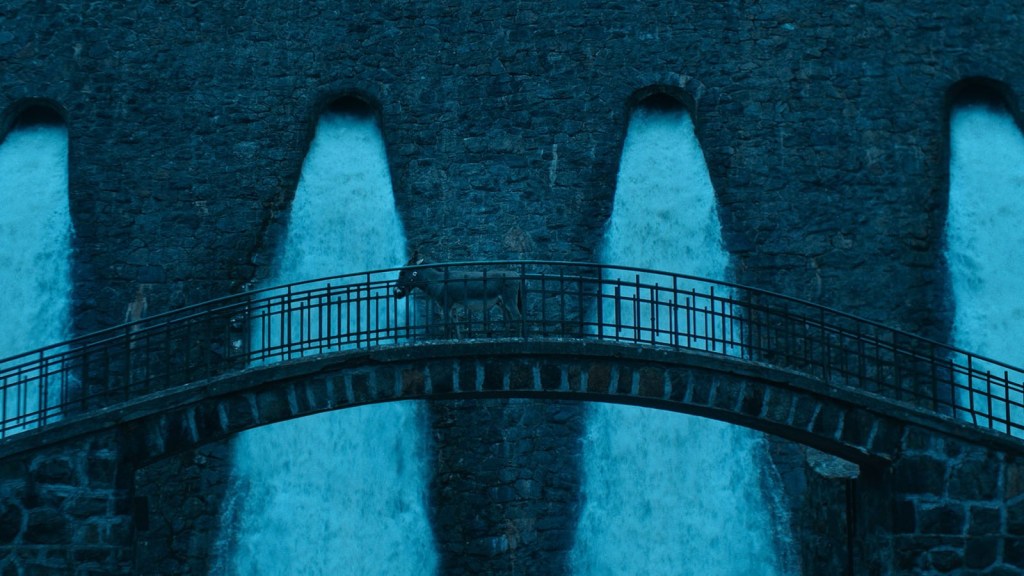
Venerable Polish arthouse director Jerzy Skolimowski brings us a challenging, immersive, and deeply political vision of what life looks like for a humble creature in a world dominated by humans. An animal rights fable for our modern age, the film centres around EO, a grey donkey with mournful eyes. It begins in a Polish circus, where the titular equine performs under the big top with his trainer Kasandra (Sandra Drzymalska), with whom he has a special bond. Kasandra views EO as both a partner and a friend, defending him from abuse. This does not last long, though, as the circus is soon shut down due to bankruptcy and protests of animal abuse from activists, and we are thrown into this most unusual of road movies.
Layered with symbolism like any good fairytale, the film takes us on a journey from gentle delight to the depths of brutality. While EO is occasionally treated well by humans, this often isn’t the case; a sad reflection of the plight of many in a world of factory farming and exploitation. This mistreatment is directed towards creatures both captive and wild, but our species is not spared either; human relationships are often depicted as fractured and broken. Rival football fans turn on each other. Families feud. At least one murder is committed, maybe two. Throughout it all, questions arise from EO’s gentle demeanour and unsurprised countenance: who is the real beast? And who are we as humans to claim dominion over all other species?
A central theme here is the division between humanity and nature that is rampant in the ‘developed’ world. Domesticated animals are showcased as nothing more than beasts of burden or tools of gratification. In contrast, wild animals are shown as free, independent and utterly uncaring about the world of humans. EO’s short forays into the wild, however, show how dependent we have made such domesticated creatures, and, therefore, how as their captors it is incumbent upon us to treat them well.
EO’s frequent escapes from captivity indicate a desire to break free, but his wanderings – and swift recaptures – often leave us with the feeling he is just as separated from nature as most of us find ourselves in this mechanised world. Oftentimes, scenes of animals in their natural environment appear eerie and drenched in red (ironically, a colour equines cannot see), as when EO wanders alone through a forest. These creatures, largely untethered from human whims, appear to be implicitly threatening as a result of their freedom. It’s clear that imposing our will on domesticated animals has left them alienated from nature with us.
As EO progresses, the exploitation of animals and the natural environment at large is further examined, as are our fumbled attempts to take action. Such moments often bring to mind the common aphorism that the road to hell is paved with good intentions. Animal rights protesters fail to consider what will become of animals set free. A lone anarchist’s actions lead to EO’s near death as angry football fans turn on him. In one particularly memorable scene, we see wind turbines in a distant forest, seeming symbols of our progression towards action on climate change. A moment later, however, a bloodied bird drops from the sky, expiring. Perhaps, if we were not so divided from the natural way of things, we would see more clearly the danger of the law of unintended consequences?
Likewise, the film portrays how our divorce from nature has led to distorted imitation. One scene of a headless robot dog, drenched in the colour of freshly spilt blood, highlights the grotesque nature of our relationship: we imitate our environment, but have produced something closer to a zombie insect, void of warmth. Rather than nurture what we have, we crudely imitate it to suit our ends.
The harsh impact of living in an anthropocentric world hangs over this film like a fog. The allusions to environmental destruction, the cheapness of life, and the loss of wild places is wrought in poetic detail. While it was often difficult to watch, it was certainly a more-than-excellent contender for Best International Feature at this year’s Academy Awards. EO sounds a warning that will stay with you long after the credits.
EO can be seen in cinemas now, including with the Film Society at Cinema Nova on Friday the 14th of April at 2:40 pm.
 MELBOURNE UNIVERSITY FILM INQUIRER