By Lachlan Gallagher
Well, the Oscars have come and gone once again for another year, to be carried away to afterparties and then deposited shining on a select few winners’ shelves. You can find a full list of all the winners below, followed by some facts and figures, analysis, and thoughts, to do with what won, what didn’t, and the presentation of the 95th Academy Awards ceremony itself. If you missed the latter but would still like to watch it, you can currently do so on 7plus here.
Best Picture
Everything Everywhere All at Once — Daniel Kwan, Daniel Scheinert and Jonathan Wang, producers
All Quiet on the Western Front — Malte Grunert, producer
Avatar: The Way of Water — James Cameron and Jon Landau, producers
The Banshees of Inisherin — Graham Broadbent, Pete Czernin and Martin McDonagh, producers
Elvis — Baz Luhrmann, Catherine Martin, Gail Berman, Patrick McCormick and Schuyler Weiss, producers
The Fabelmans — Kristie Macosko Krieger, Steven Spielberg and Tony Kushner, producers
Tár — Todd Field, Alexandra Milchan and Scott Lambert, producers
Top Gun: Maverick — Tom Cruise, Christopher McQuarrie, David Ellison and Jerry Bruckheimer, producers
Triangle of Sadness — Erik Hemmendorff and Philippe Bober, producers
Women Talking — Dede Gardner, Jeremy Kleiner and Frances McDormand, producers
Best Lead Actress
Michelle Yeoh (Everything Everywhere All at Once)
Cate Blanchett (Tár)
Ana de Armas (Blonde)
Andrea Riseborough (To Leslie)
Michelle Williams (The Fabelmans)
Best Lead Actor
Brendan Fraser (The Whale)
Austin Butler (Elvis)
Colin Farrell (The Banshees of Inisherin)
Paul Mescal (Aftersun)
Bill Nighy (Living)
Best Director
Daniel Kwan, Daniel Scheinert (Everything Everywhere All at Once)
Martin McDonagh (The Banshees of Inisherin)
Steven Spielberg (The Fabelmans)
Todd Field (Tár)
Ruben Östlund (Triangle of Sadness)
Best Film Editing
Everything Everywhere All at Once — Paul Rogers
The Banshees of Inisherin — Mikkel E.G. Nielsen
Elvis — Matt Villa and Jonathan Redmond
Tár — Monika Willi
Top Gun: Maverick — Eddie Hamilton
Best Original Song
“Naatu Naatu” from RRR — music by M.M. Keeravaani, lyric by Chandrabose
“Applause” from Tell It Like a Woman — music and lyric by Diane Warren
“Hold My Hand” from Top Gun: Maverick — music and lyric by Lady Gaga and BloodPop
“Lift Me Up” from Black Panther: Wakanda Forever — music by Tems, Rihanna, Ryan Coogler and Ludwig Goransson; lyric by Tems and Ryan Coogler
“This Is a Life” from Everything Everywhere All at Once — music by Ryan Lott, David Byrne and Mitski; lyric by Ryan Lott and David Byrne
Best Sound
Top Gun: Maverick — Mark Weingarten, James H. Mather, Al Nelson, Chris Burdon and Mark Taylor
All Quiet on the Western Front — Viktor Prášil, Frank Kruse, Markus Stemler, Lars Ginzel and Stefan Korte
Avatar: The Way of Water — Julian Howarth, Gwendolyn Yates Whittle, Dick Bernstein, Christopher Boyes, Gary Summers and Michael Hedges
The Batman — Stuart Wilson, William Files, Douglas Murray and Andy Nelson
Elvis — David Lee, Wayne Pashley, Andy Nelson and Michael Keller
Best Adapted Screenplay
Women Talking — Sarah Polley
All Quiet on the Western Front — Edward Berger, Lesley Paterson and Ian Stokell
Glass Onion: A Knives Out Mystery — Rian Johnson
Living — Kazuo Ishiguro
Top Gun: Maverick — screenplay by Ehren Kruger, Eric Warren Singer and Christopher McQuarrie; story by Peter Craig and Justin Marks
Best Original Screenplay
Everything Everywhere All at Once — Daniel Kwan and Daniel Scheinert
The Banshees of Inisherin — Martin McDonagh
The Fabelmans — Steven Spielberg and Tony Kushner
Tár — Todd Field
Triangle of Sadness — Ruben Östlund
Best Visual Effects
Avatar: The Way of Water — Joe Letteri, Richard Baneham, Eric Saindon and Daniel Barrett
All Quiet on the Western Front — Frank Petzold, Viktor Müller, Markus Frank and Kamil Jafar
The Batman — Dan Lemmon, Russell Earl, Anders Langlands and Dominic Tuohy
Black Panther: Wakanda Forever — Geoffrey Baumann, Craig Hammack, R. Christopher White and Dan Sudick
Top Gun: Maverick — Ryan Tudhope, Seth Hill, Bryan Litson and Scott R. Fisher
Best Original Score
All Quiet on the Western Front — Volker Bertelmann
Babylon — Justin Hurwitz
The Banshees of Inisherin — Carter Burwell
Everything Everywhere All at Once — Son Lux
The Fabelmans — John Williams
Best Production Design
All Quiet on the Western Front — production design by Christian M. Goldbeck, set decoration by Ernestine Hipper
Avatar: The Way of Water — production design by Dylan Cole and Ben Procter, set decoration by Vanessa Cole
Babylon — production design by Florencia Martin, set decoration by Anthony Carlino
Elvis — production design by Catherine Martin and Karen Murphy, set decoration by Bev Dunn
The Fabelmans — production design by Rick Carter, set decoration by Karen O’Hara
Best Animated Short Film
The Boy, the Mole, the Fox and the Horse — Charlie Mackesy and Matthew Freud
The Flying Sailor — Amanda Forbis and Wendy Tilby
Ice Merchants — João Gonzalez and Bruno Caetano
My Year of Dicks — Sara Gunnarsdóttir and Pamela Ribon
An Ostrich Told Me the World Is Fake and I Think I Believe It — Lachlan Pendragon
Best Documentary Short Film
The Elephant Whisperers — Kartiki Gonsalves and Guneet Monga
Haulout — Evgenia Arbugaeva and Maxim Arbugaev
How Do You Measure a Year? — Jay Rosenblatt
The Martha Mitchell Effect — Anne Alvergue and Beth Levison
Stranger at the Gate — Joshua Seftel and Conall Jones
Best International Feature Film
All Quiet on the Western Front (Germany)
Argentina, 1985 (Argentina)
Close (Belgium)
EO (Poland)
The Quiet Girl (Ireland)
Best Costume Design
Black Panther: Wakanda Forever — Ruth E. Carter
Babylon — Mary Zophres
Elvis — Catherine Martin
Everything Everywhere All at Once — Shirley Kurata
Mrs. Harris Goes to Paris — Jenny Beavan
Best Makeup and Hairstyling
The Whale — Adrien Morot, Judy Chin and Anne Marie Bradley
All Quiet on the Western Front — Heike Merker and Linda Eisenhamerová
The Batman — Naomi Donne, Mike Marino and Mike Fontaine
Black Panther: Wakanda Forever — Camille Friend and Joel Harlow
Elvis — Mark Coulier, Jason Baird and Aldo Signoretti
Best Cinematography
All Quiet on the Western Front — James Friend
Bardo, False Chronicle of a Handful of Truths — Darius Khondji
Elvis — Mandy Walker
Empire of Light — Roger Deakins
Tár — Florian Hoffmeister
Best Live Action Short
An Irish Goodbye — Tom Berkeley and Ross White
Ivalu — Anders Walter and Rebecca Pruzan
Le Pupille — Alice Rohrwacher and Alfonso Cuarón
Night Ride — Eirik Tveiten and Gaute Lid Larssen
The Red Suitcase — Cyrus Neshvad
Best Documentary Feature Film
Navalny — Daniel Roher, Odessa Rae, Diane Becker, Melanie Miller and Shane Boris
All That Breathes — Shaunak Sen, Aman Mann and Teddy Leifer
All the Beauty and the Bloodshed — Laura Poitras, Howard Gertler, John Lyons, Nan Goldin and Yoni Golijov
Fire of Love — Sara Dosa, Shane Boris and Ina Fichman
A House Made of Splinters — Simon Lereng Wilmont and Monica Hellström
Best Supporting Actress
Jamie Lee Curtis (Everything Everywhere All at Once)
Angela Bassett (Black Panther: Wakanda Forever)
Hong Chau (The Whale)
Kerry Condon (The Banshees of Inisherin)
Stephanie Hsu (Everything Everywhere All at Once)
Best Supporting Actor
Ke Huy Quan (Everything Everywhere All at Once)
Brendan Gleeson (The Banshees of Inisherin)
Brian Tyree Henry (Causeway)
Judd Hirsch (The Fabelmans)
Barry Keoghan (The Banshees of Inisherin)
Best Animated Feature Film
Guillermo del Toro’s Pinocchio — Guillermo del Toro, Mark Gustafson, Gary Ungar and Alex Bulkley
Marcel the Shell With Shoes On — Dean Fleischer Camp, Elisabeth Holm, Andrew Goldman, Caroline Kaplan and Paul Mezey
Puss in Boots: The Last Wish — Joel Crawford and Mark Swift
The Sea Beast — Chris Williams and Jed Schlanger
Turning Red — Domee Shi and Lindsey Collins
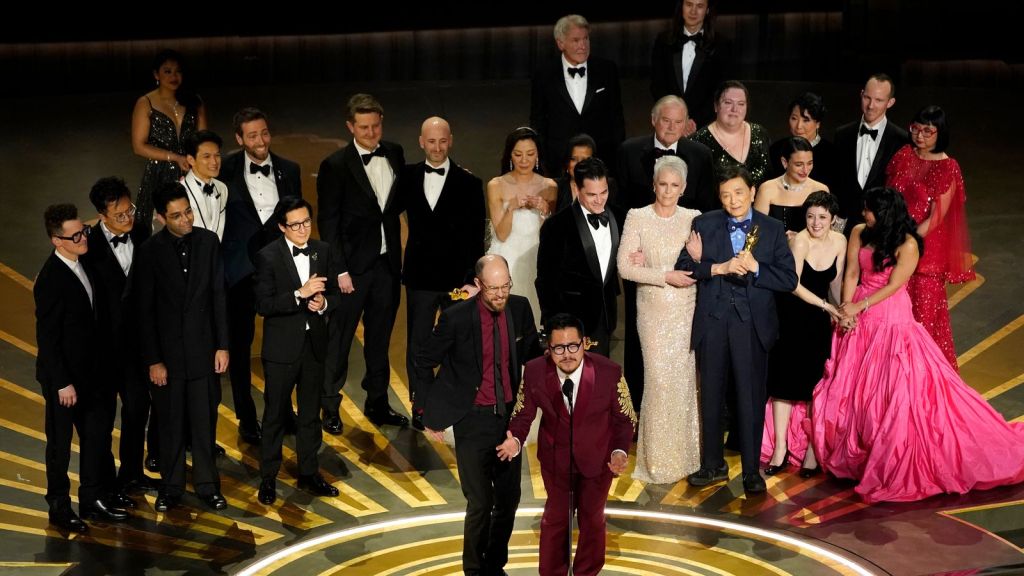
The big winner of the night (or day Australian time), of course, was Everything Everywhere All at Once, which took home seven wins from its eleven nominations, including the big one, Best Picture, as well as Best Director, Best Original Screenplay, Best Editing, and three of the acting awards, for Actresses Lead and Supporting, and Supporting Actor. Talk about every Oscar everywhere all at once! That’s the biggest sweep since Slumdog Millionaire’s eight wins in 2009, after which the Best Picture category expanded back to allowing ten nominees rather than just five, and has also earned EEAAO the bonus achievement of the movie with the most ‘above-the-line’ awards (which comprise Best Picture, Director, the four acting categories, and the two Screenplay ones) in the Oscars’ history, with six out of the eight, out of a possible seven given the division of screenplays, won.
The other big winner of the night was All Quiet on the Western Front, which took away four awards: Best International Feature Film, Best Cinematography, Best Original Score, and Best Production Design. Not so quiet now. Its victories come 92 years after the previous film adaptation of Erich Maria Remarque’s same name book won Best Picture (then called Outstanding Production) and Best Director at the 1930 Academy Awards. It ties with Fanny and Alexander (1982), Crouching Tiger, Hidden Dragon (2000), and Parasite (2019) as the most-awarded non-English language film in the Oscars’ history.
The Whale followed next in scale with two wins, Brendan Fraser bringing his feel good Brenaissance comeback tour to a crescendo by swallowing the competition (metaphorically, of course) to be crowned Best Actor over Austin “the King, Elvis” Butler, and a victory for the film in Best Makeup and Hairstyling too, in recognition of the team that helped bring Fraser’s performance to life.
Taking away one win each meanwhile were Women Talking, RRR, (Mark Gustafson and) Guillermo del Toro’s Pinocchio, Avatar: The Way of Water, Black Panther: Wakanda Forever, Top Gun: Maverick, Navalny, The Elephant Whisperers, An Irish Goodbye, and The Boy, the Mole, the Fox and the Horse.
Malaysian Michelle Yeoh made history (in a very close race against odds favourite Cate Blanchett) by becoming the first Asian actress and just the second person of colour to win Best Actress, following Halle Berry’s win in 2001 for Monster’s Ball, with Berry fittingly enough on hand to present the statue to Yeoh alongside Jessica Chastain, last year’s winner. Ke Huy Quan is meanwhile now only the second Asian actor to have won Best Supporting Actor. And Wakanda Forever costume designer Ruth E. Carter the first Black woman to have won two Oscars.
As a night of big wins for some, it was also on the flip side one of big losses for others. Five of the ten Best Picture nominees failed to score any statues, those being The Banshees of Inisherin, which was nominated for nine, Elvis, which was up for eight, The Fabelmans, up for seven, Tár, up for six, and Triangle of Sadness, up for (a fitting) three. From conversations with people, some of these losses were cause for cheers of joy (see the divisive Elvis) and others for cries of sadness (see Banshees and Tár). But whatever the case, they all retain the distinguished privilege of at least having been nominated, unlike, say, Decision to Leave, one of my 2022 faves. And many of the creatives behind them will no doubt be back one day. Other multi-nominees that went away empty-handed were Babylon (three noms), superhero movie (turned superzero) The Batman (three noms), and Living (two noms).
The most polarising winners, based on internet chatter, were Jamie Lee Curtis (for Best Supporting Actress, which she claimed over frontrunner Angela Bassett) and All Quiet (for its various wins), due to opinions on their worthiness and prominence versus others’, and impressions of the latter (including by those yet to see it, being perhaps the least watched Best Picture nominee, even after Women Talking) as just yet another boring war movie. Of course, while Lee Curtis may have benefited from a willingness among voters to recognise her broader legacy, and All Quiet from perceived anti-war timeliness (also see here Best Doco winner Navalny– finally out of opposition!- which beat another of my 2022 faves, Fire of Love), each ran a strong campaign that evidently demonstrated their merits, with Lee Curtis’ also helping to champion her film as a whole.
Having produced and locally distributed EEAAO and The Whale, A24 was the most successful of the studios represented. The other above-the-line winner, Women Talking (for Best Adapted Screenplay), was distributed in America by United Artists Releasing after being produced by Orion Pictures, Plan B Entertainment, and Hear/Say Productions. Not to be scoffed at either was Netflix, global distributor of the Amusement Park produced All Quiet, and producer and distributor of Pinocchio. Among streamers, Apple TV+ took a win too with The Boy, the Mole, the Fox and the Horse for Best Animated Short.
Considering the ceremony itself, my vote goes to Jimmy Kimmel having done a decent job this time round, with a few actually laugh out loud wisecracks from him and his writers, and a sensible balance, for the most part, between shaking the hand that feeds and biting it. Of course, not every bit landed. The Cocaine Bear appearing on stage with a croaky Elizabeth Banks to present Best VFX was fun; the Cocaine Bear then attacking Nobel Peace Prize Winner Malala Yousafzai less so. That Yousafzai diplomatically brushed off Kimmel’s nonsense saved this from being the worst moment of the night however. Instead, that dishonour goes to Triangle of Sadness co-star Charlbi Dean Kriek’s and others’ exclusion from the In Memoriam segment (RIP).
Thankfully though, aside from these gaffes, the controversy earlier in the season over Andrea Riseborough’s nomination campaign, and much less but nonetheless controversy over Chinese Communist Party linked actor Donnie Yen being a presenter, this year, unlike the films featured, was relatively drama free, with nothing on the level of last year’s seismic slap. We just got a lot of slap jokes instead. In notable course corrections, all awards were presented live again, and the lauding of animation to kick things off seemed an attempt to make up for backlash against the infantilisation of the art form in 2022.
The best speeches came from from RRR‘s Naatu Naatu song makers M.M. Keeravaani and Chandrabose (the performance of which earlier was definitely a highlight), EEAAO writer–directors the Daniels, The Boy, the Mole, the Fox and the Horse‘s Charlie Mackesy and Matthew Freuds, Women Talking writer-director Sarah Polley, Ke Huy Quan, Michelle Yeoh, and Brendan Fraser. But, honestly, they were all pretty good. On the topic of speeches, it seems likely that in the rush of the moment EEAAO producer Jonathan Wang got his words round the wrong way when he said, “no person is more important than profits”. Or, maybe he just likes money and was recognising how movies take it to make, and are usually a commercial endeavour. EEAAO has made a nice chunk of change itself, having hauled $106 million USD at the global box office so far from a budget of $25 million thanks to steady holds in theatres off of incredible word of mouth.
Overall, while they may still be elites backed by millionaires, this year’s Academy Awards did feel like a night of underdogs (or rather, underhotdogfingers) finally triumphing. The individual winners’ personal stories and accounts speak for themselves. To focus on the Best Picture again: Everything Everywhere All at Once may have gone into this Oscars as either the clear frontrunner or one of them in most of its races, but it started as and remains a quirky little synthesis of emotional melodrama, comedy and action, effects and philosophy, an experimental film with experimental visuals and music crafting crudeness into catharsis, about diaspora destinies, middle aged malaise, and finding empathy in the face of ennui and generational jumps. Featuring performers from backgrounds once rarely represented in Hollywood. That is to say, a movie with a little of everything, and the type of independent film that would not necessarily have gotten the accolades it rightfully deserves in the world of the past, but, thanks to the work of those who have come before and its own popular brilliance, has in the world of the present.

 MELBOURNE UNIVERSITY FILM INQUIRER