By Jordan Low
For his first film in five years, Darren Aronofsky directs a screenplay by Samuel D. Hunter based on Hunter’s 2012 stage play of the same name: The Whale. Morbidly obese, Charlie (Brendan Fraser) struggles through life with the help of his nurse, Liz (Hong Chau), but gains hope as his daughter, Ellie (Sadie Sink), re-enters his life behind his ex-wife’s (Samantha Morton) back.
Most of the buzz surrounding the movie has been centered around Fraser’s performance, and I am happy to report that it is well-deserved. Underneath the impressive prosthetics, Fraser imbues Charlie with humanity and humour, as the wide-eyed charisma that made flawed movies like Encino Man (1992) and George of the Jungle (1997) so entertaining is used here to its full potential. In many ways, Fraser is playing the opposite of his role in the underrated Gods and Monsters (1998); once the desirable gardener, he is now the also-ran yearning for a lost love (akin to James Whale in that film).
The titular whale, made obvious by a recurring essay on Moby-Dick Charlie reads throughout the film, represents not just Charlie’s physique, but the happiness and love that eludes him. Charlie, like Ahab, fails to move on from his obsession (in this case his late boyfriend) and in the process destroys his own life. As the movie goes on, another side of Charlie comes to the fore; a palpable sense of self-hate that manifests through binge-eating and overly optimistic denial about his health. After The Wrestler (2008) and Black Swan (2010), Aronofsky once again delves into the psyche of a person who was once desired, but where those two films see their protagonists respond with determination, Charlie takes the path of self-loathing.
While Fraser strikes a great balance between pathetic and sympathetic, much of the credit also goes to Chau and Sink, both of whom are given plenty of Oscar-friendly scenes to showcase their skills. Unfortunately, that also links to the main flaw of the film, which is its inability to shed its stage roots. Like many screen adaptations of plays, The Whale too often feels just like that; a play on screen that fails to fully embrace the potential of film. Characters come in and out of a single set to shout, there are one too many exposition-filled monologues, and everything wraps up a tad too neatly. New Life missionary Thomas (Ty Simpkins) feels like one such vestige; he exists mainly to tie up loose ends of the other characters, and the more his storyline progresses, the more artificial Charlie’s story feels. Likewise, the score by Rob Simonsen is cloying, and every swell of the music only enhances the sense of artificiality. Silence and nuance, used to such great effect in some of Aronofsky’s previous films, seems to be sidelined for now.
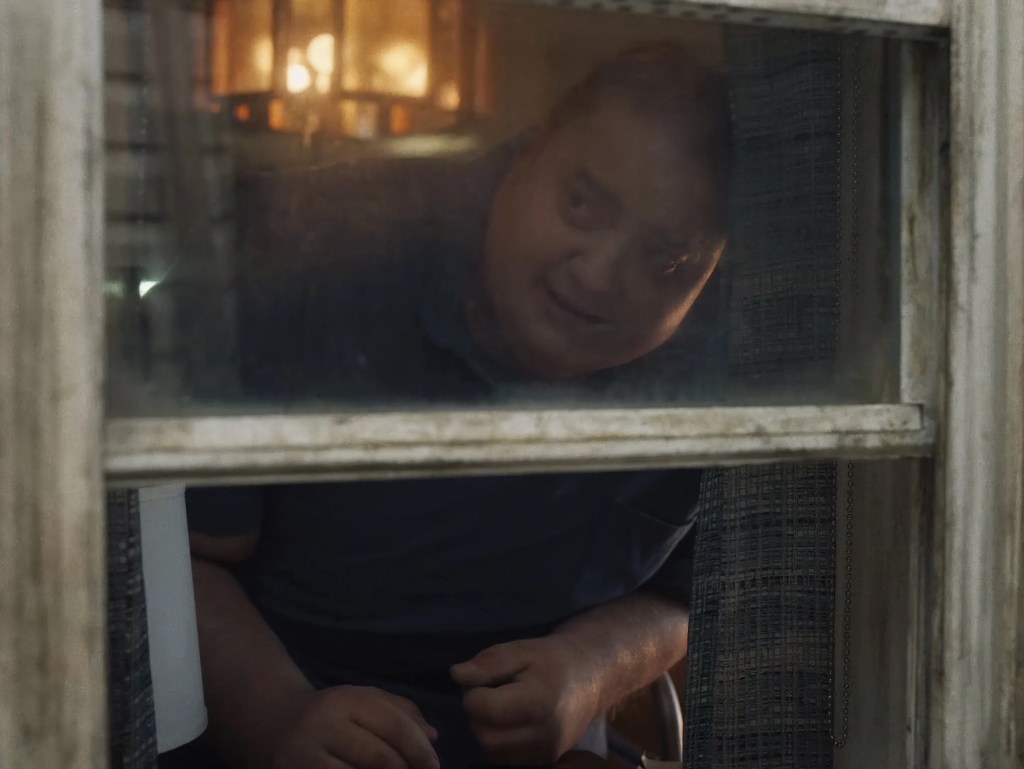
Thankfully, the single setting works for the film, as we come to inhabit the same drab space as Charlie and feel the depressing monotony of being housebound. Reinforcing this, Sink, Chau, and Morton zip around the living room to the point of excess while the camera mostly pivots around from Charlie’s point of view.
Inevitably, the film also makes a commentary on the American healthcare system and the nation’s problem with obesity. There is a lot to unpack regarding Charlie’s own condition, with hints of it being self-imposed or caused by his depression, as well as his refusal to visit a hospital due to a supposed lack of insurance. Then there are the different ways people around him treat his obesity: empathy/enablement (Liz), pity (Thomas), and disgust (everyone else). Through Thomas, faith, religion, and how it interacts with self-belief is also touched upon, all themes that Aronofsky explored in Noah (2014) and Mother! (2017). More interesting perhaps is how this plays against the healthcare system. The omnipresence by which the church is depicted, compared to how fast consumerism and non-universal healthcare have failed people like Charlie, seems to be an intentional contrast.
Mass-produced junk food leads to poor health outcomes, but when individuals cannot afford to take care of their physical selves, spiritual guidance is traditionally touted as a non-judgemental haven. However, as evident from Liz’s personal tragedy, that guidance may in turn lead to its own set of negative results, which in the case of Charlie, is more fast consumption. This creates a loop that is all too common for people on the fringes of society, where loved ones (and governments) have seemingly given up hope for them.
For all its flaws, Aronofsky and Hunter have crafted the perfect vehicle for Fraser to finally showcase his talents again, and he and the rest of the cast deliver in spades to elevate the material.
Rating: 8/10
The Whale can be seen in cinemas now.
 MELBOURNE UNIVERSITY FILM INQUIRER