By Jordan Low
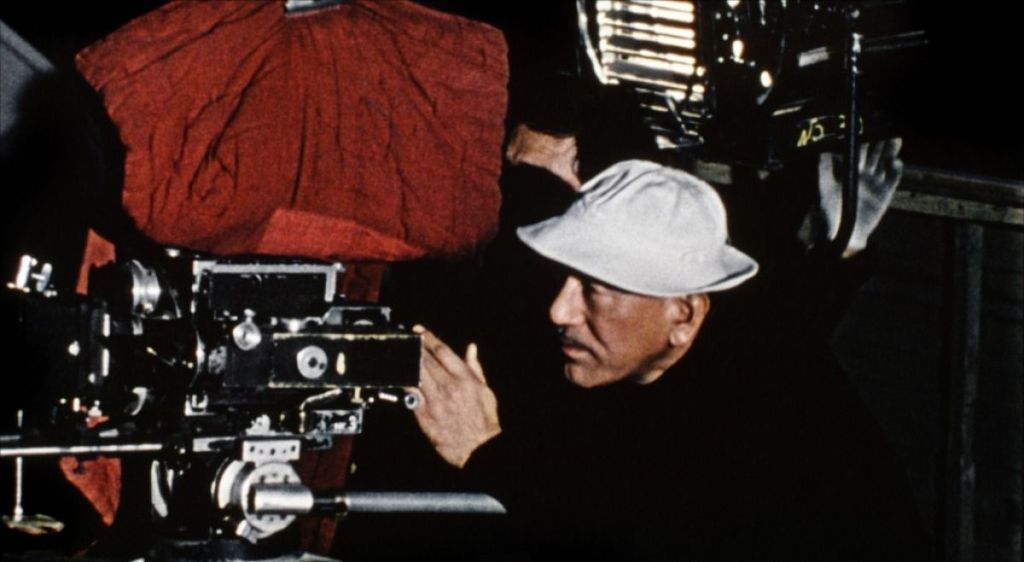
Yasujirō Ozu is widely regarded by audiences and filmmakers as one of the most influential directors in history. His focus on quiet character moments rather than major events stood out among other films of their time. Even then, character interactions typically involved peaceful conversations rather than melodrama, where feelings are felt through expressions rather than dialogue. Ozu was also a pioneer in his restrained camerawork and ‘pillow shots’, where, instead of fades, he inserted scenes of objects or scenery that sometimes added meaning to the bookending scenes.
Given that Ozu made over fifty films, with many of his silent era films permanently lost, this piece will focus on the period this reviewer believes to be his peak: the colour era. While his most beloved film, Tokyo Story (just see the BFI’s latest greatest of all time lists), was released in 1953 in black and white, his final six colour films stand out as some of the best filmmaking of Ozu’s extremely prolific career, as his technique and narrative formula came close to being perfected. It is hoped that this piece will serve as a celebration of his work, and possibly interest readers into trying out one, or more, of his movies.
Equinox Flower (1958)
Ozu’s first colour film concerns a father, Wataru (Shin Saburi), who arranges a marriage for his daughter Setsuko (Ineko Arima), but is disappointed to learn she has plans of her own. When her suitor turns up to ask Wataru for his blessing, he is angry at first but resolves to find out more about this suitor from the people around him. Later, Setsuko’s friend asks Wataru for advice as her own father is setting her up (a lie she created to test Wataru). Revealing his hypocrisy, he advises the friend to do what makes her happy and ignore her father. In the most powerful scene of the film, Setsuko confronts her dad by telling him: ‘You should have a little more trust in me’. In the end, Wataru comes to accept his daughter’s agency and the film ends with him on a train to see the new couple.
Despite Ozu’s trademark themes of familial responsibility and independence, Equinox Flower manages to keep things fresh by focusing on a subtly misogynistic middle-aged man rather than a homely father. In keeping with this theme, the film opens with two station workers objectifying women passers-by, and later, Wataru jokes with his friends how they can tell a couple has sons if the woman is stronger, all laughing as a masculine waitress enters their room. As if making a statement about his new medium, Ozu picks a bright green neon billboard as one of his pillow shots, and it is hauntingly beautiful.
With great pacing, solid acting, and entertaining subplots that complement the storyline, Equinox Flower is one of Ozu’s best.
Rating: 9.5/10
Good Morning (1959)
A loose remake of his silent film I Was Born, But… (1932), Good Morning weaves two concurrent plots; one regarding two boys, Minoru (Shitara Koji) and Isamu (Masahiko Shimazu), refusing to speak to their parents until they get a new TV like their neighbour, and the other regarding a humorous case of false accusation and guilt involving a Mrs. Haraguchi (Haruko Sugimura). The title derives from the boys insisting that adults talk too much and waste time on ‘stupid pleasantries’ like ‘good morning’, hence their silent strike. Mrs. Haraguchi mistakes the strike as a statement about a mistake she once made against the family, and she spreads word around the village about the family pettily holding grudges.
In a completely bizarre choice, Ozu creates a subplot about one of the boys discovering that pressing their forehead results in a fart, and these farts continue throughout the film, especially during extended silences that are so often solemn in Ozu’s other films. One can’t help but think this surprisingly absurdist humour influenced the extensive use of flatulence in Swiss Army Man (2016).
Behind the humour and hijinks, the film touches on the serious theme of communication. The parents’ refusal to buy a TV reflected many traditional families’ reluctance to accept modernity and their slow loss of control over what enters the home. By having the boys be silent, barring flatulence, Ozu not only encapsulates parents’ frustration in communicating with their children, but also children’s inability to understand why adults cling so hard to tradition in refusal of progress.
Rating: 8.5/10
Floating Weeds (1959)
Another remake of an earlier film, Floating Weeds covers a Kabuki troupe that comes to a fishing town to perform. While they hand out flyers, the lead actor Komajuro (Nakamura Ganjirō II) visits his ex-wife and long-lost son who thinks he is an uncle. Father and son bond through board games, but trouble ensues when Komajuro’s current girlfriend, who happens to be the troupe’s lead actress, confronts the ex-wife.
Following Good Morning, Ozu once again covers modernity through the struggling Kabuki troupe. In the opening scene, we hear a man preferring a modern strip show over the ‘outdated’ Kabuki. After the big performance, the son tells Komajuro that a character in the play is unrealistic and doesn’t relate to ‘today’s world’. Unlike Ozu’s usual mellow protagonists, Komajuro is more akin to Toshiro Mifune’s characters in the films of Akira Kurosawa: he is physically violent, shouts profanities at women, and refuses to accept his place in a world that no longer needs him, both professionally and in his private life. It is perhaps intentional that his Kabuki character is also a tough guy, which suggests that he believes this to be the ideal in the real world too.
The film is home to one of the most striking scenes in Ozu’s filmography, where actor and actress argue across each other and break up while under two separate roofs, the pouring rain in between them.
Complex characters, ever-relevant themes, and top-notch technical filmmaking make Floating Weeds another fantastic Ozu entry.
Rating: 9/10
Late Autumn (1960)
When a patriarch dies, his three friends try to marry his daughter Ayako (Yoko Tsukasa) off while pining for the widow Akiko (Ozu stalwart Setsuko Hara), who they all used to pursue in their youth. Ayako insists to Akiko that she’s fine being single, but Akiko doesn’t believe it and suspects she must secretly like someone. A powerfully quiet moment perhaps signals to the audience that Akiko used to be like that (not to mention Hara herself in past Ozu movies). Throughout the rest of the film, both mother and daughter try dating and reflect on whether marriage and/or companionship will really provide them what they want in life. The final shot of Setsuko Hara alone completes a real-life passing of the torch as she now takes on the role of the parent that her characters so often argued with in previous films.
In a rather progressive scene, Ayako tells the three men that she is from a new generation and “you don’t need both romance and marriage to be happy”. By the film’s end, the three men eventually respond with their own nugget of wisdom, that “we tend to make things complicated, but life’s simpler than we think”.
On the flip side, there’s a prevailing (and dated) idea in the film that if a woman doesn’t marry when young, her future husband will somehow be of decreasing quality as time progresses. Similarly, a scene which suggests men are owed a date as long as they’re ‘good’ simply did not age well.
When viewed in the context of Ozu’s other films, Late Autumn too often relies on overly familiar themes and characters. On its own however, Late Autumn remains a solid film with fantastic dialogue and beautiful camerawork.
Rating: 8/10
The End of Summer (1961)
A widowed father, Manbei (Nakamura Ganjirō II), has two daughters and one widowed daughter-in-law (Setsuko Hara as another Akiko). His brother-in-law tries to set up a disinterested Akiko with an eager friend in the first plot thread (although this plot opens the movie, we only return to it after 45 minutes). The second plot thread follows Manbei sneaking out to see his former mistress and potential illegitimate daughter who is dating a Caucasian man.
As usual for an Ozu film, there are heavy themes of familial responsibility and independence, as well as great technical filmmaking. Unusually for an Ozu film, it is rather difficult to follow with all the widows, in-laws, and various names, with insufficient introduction to each. While the ambition is respectable, it does not help that the two primary plotlines are cut between each other at varying, arbitrary occasions, resulting in a strange ratio in screen time between the two.
Thankfully, Ozu’s vision does pay off in one scene at a bicycle racing track. Given his reputation of all things peaceful and slow, the sight of vibrant streaks of colour zipping around the track is nothing short of jaw-dropping.
Rating: 7.5/10
An Autumn Afternoon (1962)
Ozu’s final film has his most frequent collaborator Chishū Ryū as Shūhei, the (once again) widowed patriarch of a family made up of a married son, Kōichi (Keiji Sada), unmarried daughter, Michiko (Shima Iwashita) and unmarried boy, Kazuo (Shin’ichirō Mikami). Shūhei and his old pals occasionally hangout and reminisce with their former teacher affectionately known as ‘The Gourd’ (Eijirō Tōno). However, Shūhei is saddened to discover their former hero is secretly now a poor noodle shop owner, and this kickstarts a reflection of his own life and past. For starters, believing that one thing that led to The Gourd’s predicament was his failure to marry his daughter off, Shūhei becomes determined to marry Michiko off as soon as possible.
Despite the usual Ozu themes and characters, it is perhaps fitting that his final film turned out to be him doing what he knows best. It is neither the most technically accomplished of his, nor is it the best written or directed, but An Autumn Afternoon is an appropriate send-off for a director who taught us so much about the value of quiet and simple pleasures.
Rating: 8/10
The first half of Yasujirō Ozu’s Equinox Flower (1958) can currently be watched here, the second half here, and the whole of Good Morning (1959) here, Floating Weeds (1959) here, Late Autumn (1960) here, and An Autumn Afternoon (1962) here.
 MELBOURNE UNIVERSITY FILM INQUIRER