By Alessandra Akerly
Spoilers
When Hayao Miyazaki was developing the film that would eventually become Kiki’s Delivery Service, he remarked how the concept of “coming of age” had changed in the modern world. Miyazaki dismissed the significance of leaving home as a “rite of passage”; after all, one only needed to “shop at the local convenience store” to achieve a sense of independence. The true challenge, Miyazaki argued, lay in the “far more difficult task” of a young woman discovering her own talents.
Studio Ghibli is famous for championing female heroes in their works, women with a depth that is, or once was, rare in Hollywood. Whether it is the bratty yet courageous Chihiro of Spirited Away, shy Sophie of Howl’s Moving Castle, or frankly unlikable Rikako of Ocean Waves, Ghibli tells stories of women taking on the world in their own way.
Two Ghibli movies where young women can be seen harnessing their creative power in order to truly come of age are Yoshifumi Kondō’s 1995 drama Whisper of the Heart and Hayao Miyazaki’s 1989 fantasy Kiki’s Delivery Service.

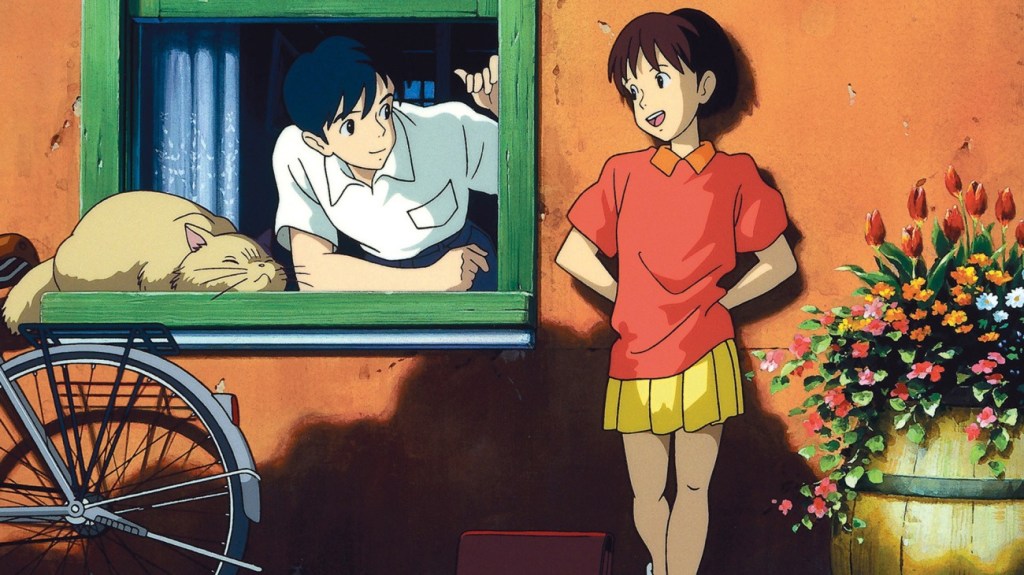
Meet Shizuku, the heroine of Whisper – a creative Tokyo schoolgirl who has since had a second career as the star of the iconic lofi hip hop radio – beats to relax/study to on YouTube. Borrowing books from her local library, she realises that all of hers have been previously checked out by a person named Seiji. Seiji is a talented violin maker who hopes to travel to England in order to hone his craft. As the two tentatively fall in love, Shizuku is inspired to write a novel of her own.
Kiki’s Delivery Service, the more famous of the two films, meanwhile follows thirteen-year-old witch Kiki as she embarks upon her mandatory year away from home, a rite of passage that all fledgling witches must undertake. As she settles into life in her new town, Kiki makes friends, encounters the difficulties of adulthood, and utilises her magic by creating a flying delivery business. But the challenges of big city life prove to be too much as she begins to lose her powers. Can Kiki regain her spark?
In both films, each girl struggles to harness their creativity. And both experience burnout, the ache to feel accepted by their peers, and, most of all, the feeling that they are not good enough for the adult world.
Kiki arrives in town a fish out of water. The other villagers and children are unwelcoming, richer and look down their noses at her, and she is made to work hard to get them to like her. Kiki’s struggle to make ends meet and adapt to her new environment will strike a chord with anyone who has newly moved away from home and found themselves subsisting on instant noodles (or pancakes) and a minimum wage job. Every setback she encounters – wild weather, snooty customers, and so on – though relatively small, to her feels astronomical.

After overworking herself on deliveries, Kiki remarks to her friend Tombo that “flying used to be fun until I started doing it for a living”. Soon after, her ability to fly disappears altogether, and she loses the magic that allows her to talk to her pet cat, Jiji.
Shizuku faces her own challenges as she seeks to write a first novel that is entirely new and unique. At the movie’s start, she is known for rewriting the lyrics to songs such as John Denver’s Take Me home, Country Roads. After encountering a mysterious statuette of a cat though, she finally feels inspired to write her book, neglecting her middle school exams in the process.
What I find most notable about Shizuku’s story is that writing is not something that comes naturally to her. Similar to Kiki, she has talent, sure, but she’s not a prodigy. She has to work to become a better artist, and her pursuit of art doesn’t come without criticism and concern. From family members who worry her writing is a distraction, or misinterpret creative drive as laziness. From Seiji who scoffs at her song lyrics (deeming them “even cornier than the original version”). And even from his kindly grandfather who remarks that her writing is “a little rough”. But though Shizuku is dismayed, she continues to write and improve.

Both these films show that Ghibli is not interested in stories about instant prodigies, but instead believes that flourishing in the adult world involves encountering setbacks and pushing through again and again. What makes them so wonderful is how both girls’ struggles are so mundane. Western coming of age films can tend to focus on life-changing friendships and events, where characters are transformed by a single defining moment that transitions them from childhood to adulthood (see Stand By Me for one example). In Ghibli’s, this transformation is less linear. True coming of age doesn’t end when you turn 18; instead it is a series of small moments, obstacles that you conquer only to encounter more of straight after. Ghibli argues that maturity is achieved by claiming your own agency – by growing a resilience to challenge and maintaining a commitment to pursue what you love.
By the end of their tales, Kiki is still not completely confident in her flying ability, and Shizuku’s story is far from complete. There is no defining moment that indicates that they have already reached their creative peak. They will continue to grow and become better at their craft. But we leave with the assumption that they will get better. It will just keep taking time. And isn’t that what ‘growing up’ is really about?
Both Whisper of the Heart and Kiki’s Delivery Service can currently be watched (with subtitles or dubs) on Netflix in Australia, or rented through a variety of other services.
 MELBOURNE UNIVERSITY FILM INQUIRER