By Max Baltas
Silence, the title of Martin Scorsese’s 2016 film, or is the word more closely aligned with the writer-director’s response to questions of morality? Scorsese, arguably the greatest director alive today, is an impartial adjudicator presiding over his own work, and one who never seems to deliver a verdict. His reluctance to provide audiences with answers to the ethical questions he explores echoes the very silence that meets the priests’ implorations to God in Silence. However, it is this which makes his work stand out. He doesn’t tell you what’s right and what’s wrong, who the ‘good guys’ and who the ‘bad guys’ are. He puts everything on the table, clear as crystal, and lets you decide. The impartiality governing the diegesis – that is, the narratives – of his films is a quality that makes Silence such a tug-of-war between one’s mind and one’s heart; will your empathy towards the Jesuit priests prevail and have you support them, or will your reasoning applied to their decisions supersede and have you scorn them? Will you rest somewhere in the middle, or will you do neither?
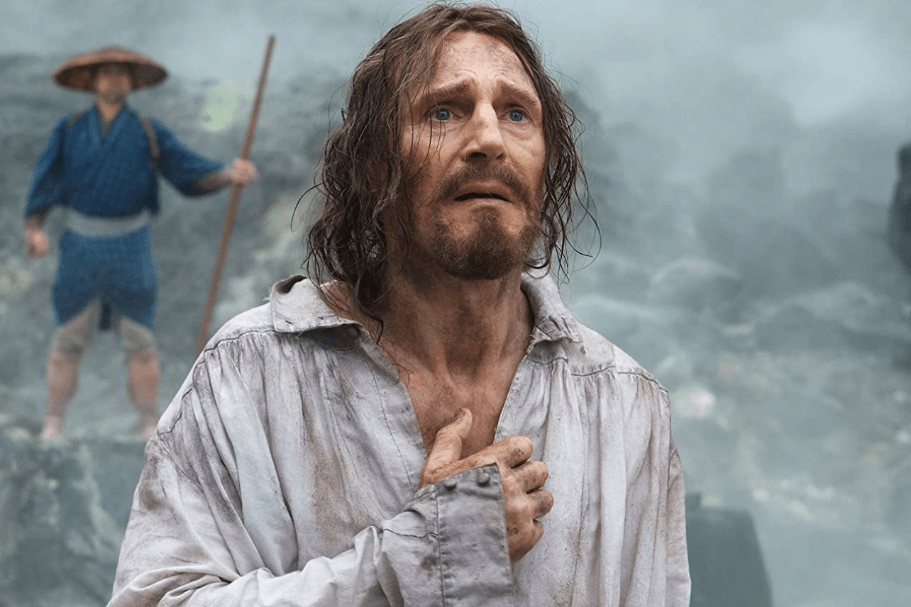
Set in 17th century Japan, Silence is about two Portuguese Jesuit priests, Father Rodrigues (Andrew Garfield) and Father Garupe (Adam Driver), who venture to the country searching for their old mentor, Father Ferreira (Liam Neeson). Ferreira went missing in his mission to spread the Christian faith throughout Japan, and rumours are that he was seized by authorities, forced to apostatise by renouncing Christianity, and is now living as a Japanese.
Apart from heart-wrenching performances by the star-studded cast and the gorgeous cinematography, it is Scorsese’s exploration of faith, which culminates in a terrible moral dilemma, that makes Silence such a magnificent film. Eventually, the two priests are caught by the authorities and are subjected to many trials and tribulations by Governor Inoue Masashige (Issey Ogata). These hardships are meant to catalyse apostasy, and by forcing the priests to renounce their faith and step on the icon of Jesus, Masashige intends to quash the presence of Christianity in Japan. This is where the dilemma begins.
The pain and suffering wrought almost seems to be welcomed by the priests: “the blood of martyrs is the seed of the church.” Believing that their trials are in the same vein as that of Jesus himself, the question of putting one’s faith before one’s well-being becomes quite a simple one. The audience is positioned to empathise with the priests, after all, they are our protagonists, and their anguish and torment are palpable. However, when Masashige puts forward instead the ultimatum of apostasy or the death of innocent Japanese villagers, a re-evaluation of ‘right and wrong’ is warranted.
Christianity is a foreign religion trying to prevail over Buddhism in Japan, thus the authorities are trying to halt its spread and preserve the beliefs intrinsic to their country, as well as protect Japan from the influence of the West. Despite being empathically aligned with the priests, and despite witnessing the atrocities committed by the authorities – peasants are drowned, burned alive, crucified, and tortured in all manners – the audience is given the opportunity to grasp the Japanese rationale. And once the priests refuse to renounce their faith as innocents are slaughtered in front of them, Scorsese turns the morally black and white diegesis to a prominent shade of grey.
Can anyone here be justified or condemned? The authorities commit heinous acts of violence, but only do so to encourage apostasy and protect Japanese culture. The priests have gone through so much pain and suffering, but are prepared to let people die so they can stay ritualistically true to God. To an atheist, the decision to apostatise may seem simple, but to a Christian, I cannot fathom how this situation could possibly be evaluated. I have even put forward this scenario to a religious friend of mine, a religion-oriented trolley problem, and both options were met with ambivalence; a definitive decision was not given.

This abstaining from judgement on behalf of Scorsese is something prominent in so many of his works. Yet this indifference is often misinterpreted as endorsement. His depiction of Jordan Belfort in The Wolf of Wall Street led some critics to believe Scorsese glorified the machismo, misogyny and utter excess contained in that film, despite it being a depiction of historical events (it might be worth mentioning that Belfort himself has stated that the representation of him was in fact “tamer” than reality). His depiction of 1970’s New York in Taxi Driver similarly led to the impression by some that Scorsese endorsed gratuitous violence given protagonist Travis Bickle goes on a shooting spree, massacring those he sees to be the “scum and filth” of society. Goodfellas and Casino get their fair share of controversy as well, often criticised for glamourising the ‘gangster lifestyle’ and everything that goes along with it.
At the end of the day, it is unfair to label Scorsese as an advocator of all these humanly vices simply because he chooses to make films on contentious issues where most directors fear to tread. Life isn’t always fair, society is not free of corruption, the good guys don’t always win, and the world is not black and white, so why do Scorsese’s films have to be? In my opinion, it is the director’s willingness to create controversial films which are morally ambiguous that makes him one of the greatest of all time. Silence, the third religious film and “passion project” of the acclaimed director, is the epitome of this controversy and moral ambiguity, and I couldn’t recommend it highly enough.
Rating: ★★★★★ / ★★★★★
Find out where to watch Silence (2016) here.
 MELBOURNE UNIVERSITY FILM INQUIRER